


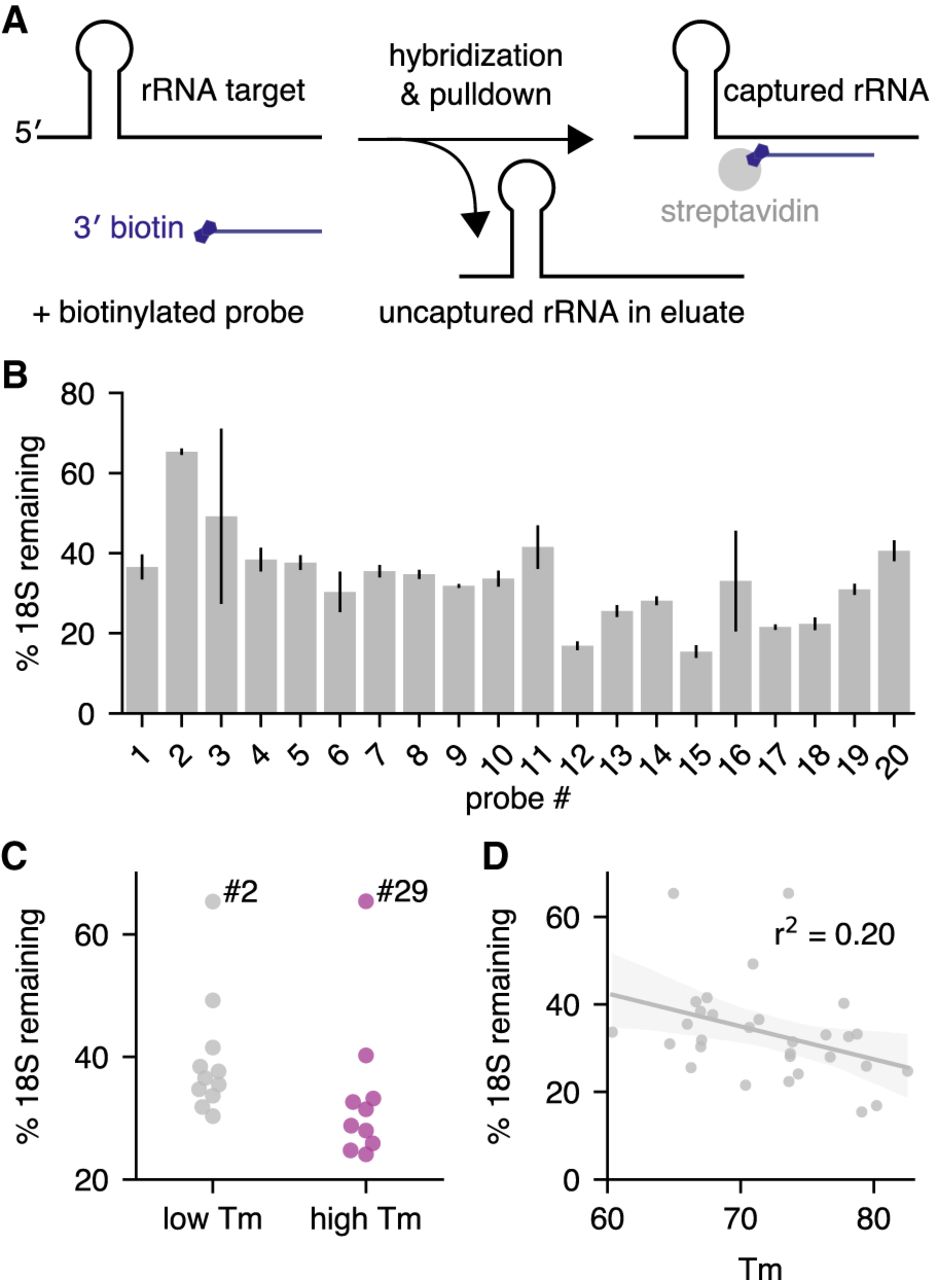
Short antisense oligos effectively deplete ribosomal RNA. Oligonucleotides targeting the Drosophila small rRNA (18S) were individually tested for their ability to deplete the 18S transcript from larval total RNA. The percent of remaining 18S was quantified by qPCR. Values are derived from 18S normalized to Act5c, in turn normalized to a nondepleted sample (no probe control). Values are the averages of three replicates of the depletion experiment, each using a different sample of larval RNA. (A) Outline of the single-probe depletion assay. A 3′ biotinylated probe targeting a specific site in the 18S is added to total RNA and subjected to hybridization. The target is captured with streptavidin beads and the remaining target is measured from the supernatant. (B) The percent of 18S rRNA remaining for all tested oligos of size 26–32 nt, arranged 5′ to 3′ by target site. Error bars are standard deviation between separate hybridization experiments, each performed with a different RNA sample. (C) Performance comparison between the initial set of low Tm probes (probes #1–#11, Tm < 72°C) targeting the left side of the 18S transcript and the second set of high Tm probes (probes #21–30, Tm > 72°C). Two-sided t-test P = 0.12. Probe #2 and probe #29 are outliers, possibly for structural reasons (see Fig. 2). (D) Correlation between the predicted Tm of the probe/target hybrid and the percent of remaining target for the 30 ∼30mer probes tested in the single-probe depletion assay (P = 0.01, Spearman's correlation).




