


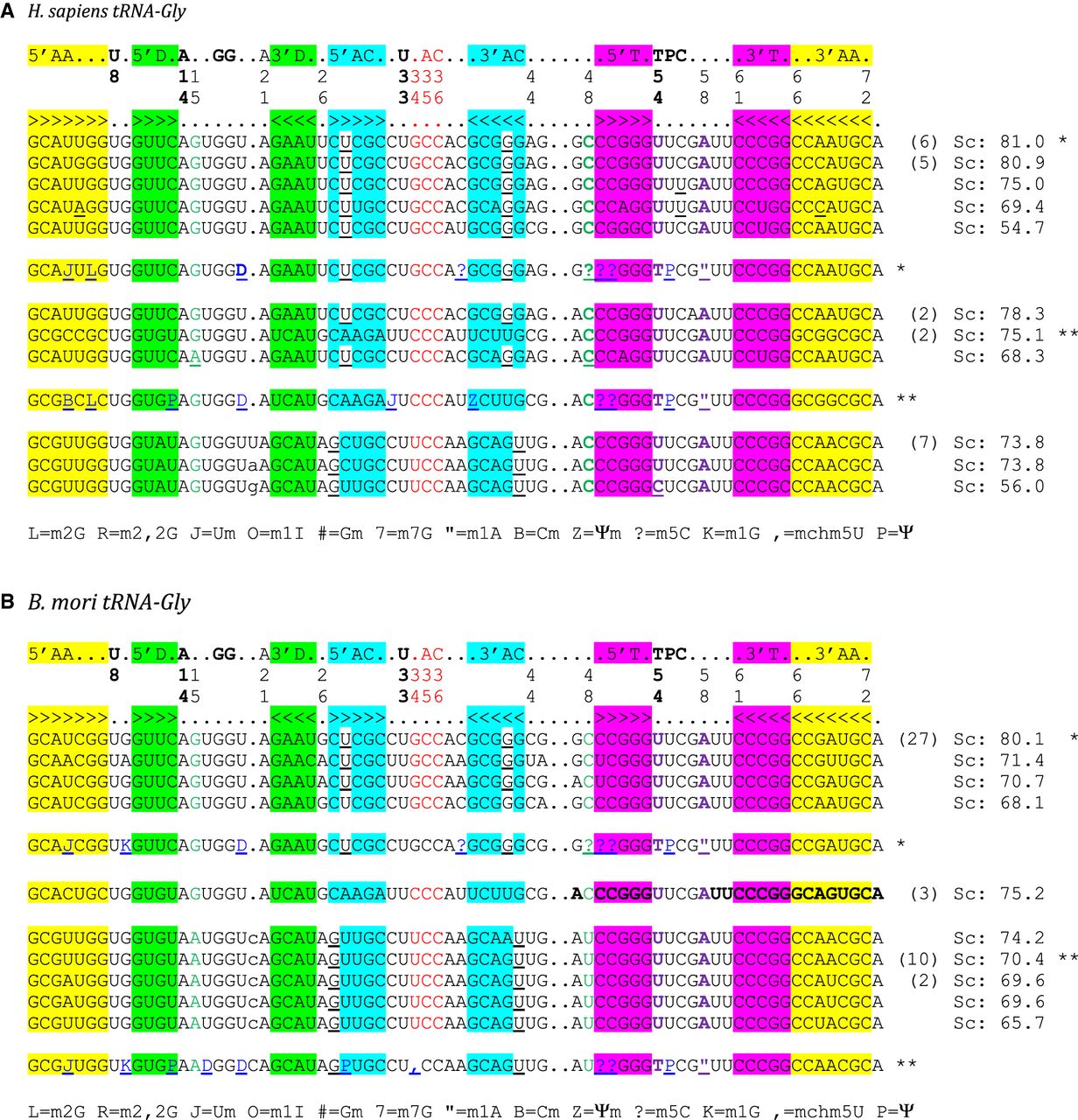
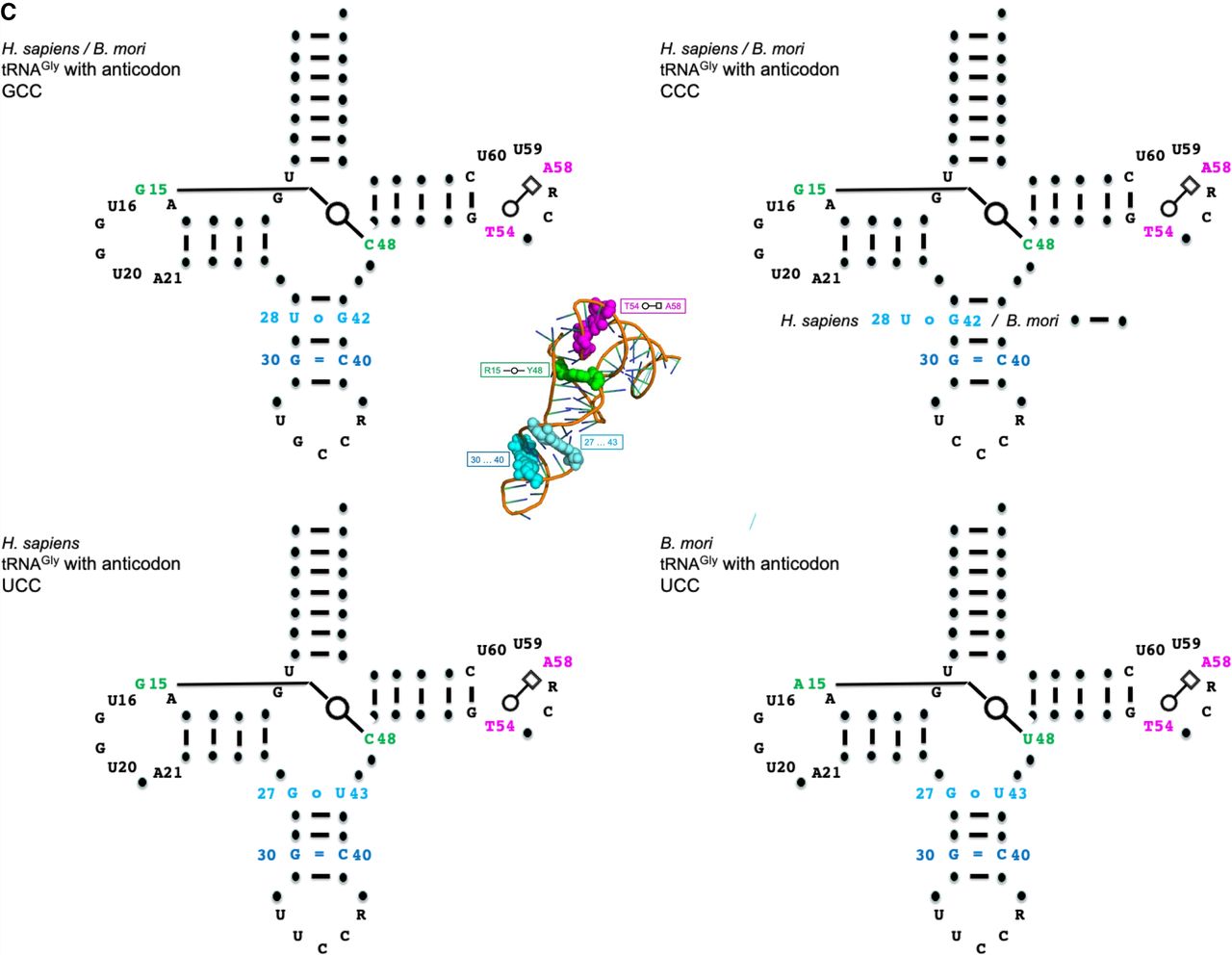
Structural alignments of tRNAGly from Homo sapiens (A) and Bombyx mori (B). The secondary structural elements of the tRNA cloverleaf are indicated above the alignments with key positions numbered following the standard nomenclature of yeast tRNAPhe. For clarity, the base-paired stems are colored (yellow for the amino acid stem; green for the dihydrouridine stem; cyan for the anticodon stem; purple for the thymine stem throughout the alignments), except for GoU pairs in the anticodon stem, which are white and underlined. The anticodon triplet is shown in red. At the right, the scores (Sc) from the tRNAscan-SE prediction algorithm (Lowe and Eddy 1997) as indicated in the database of transfer RNA genes GtRNAdb 2.0 (Chan and Lowe 2016) are shown. The number of potential tRNA gene copies is indicated next to the scores when greater than 1. Thus, for tRNAGly, there are 14 isoacceptors with anticodon GCC, five with CCC anticodons, and nine with UCC anticodons. The two tertiary pairs extensively discussed in the text are in bold and colored—green for 15/48 and magenta for 54/58. The same color code is used in the 2D and 3D representations. The sequences of the two isoacceptor tRNAGly present in the MODOMICS database (Boccaletto et al. 2018) are shown, and the code used is explained in the last line. D stands for dihydrouridine and I for inosine. The starred sequences are, respectively, the predicted and the experimentally determined sequences for a given isoacceptor. (C) Standard cloverleaf structures corresponding to the alignments with key contacts highlighted with the same color code. The Leontis–Westhof (2001) nomenclature is used for the non-Watson–Crick pairs. In the middle, a representative three-dimensional structure of a tRNA (PDB 1EHZ from Shi and Moore 2000) is shown together with base pairs discussed.




