


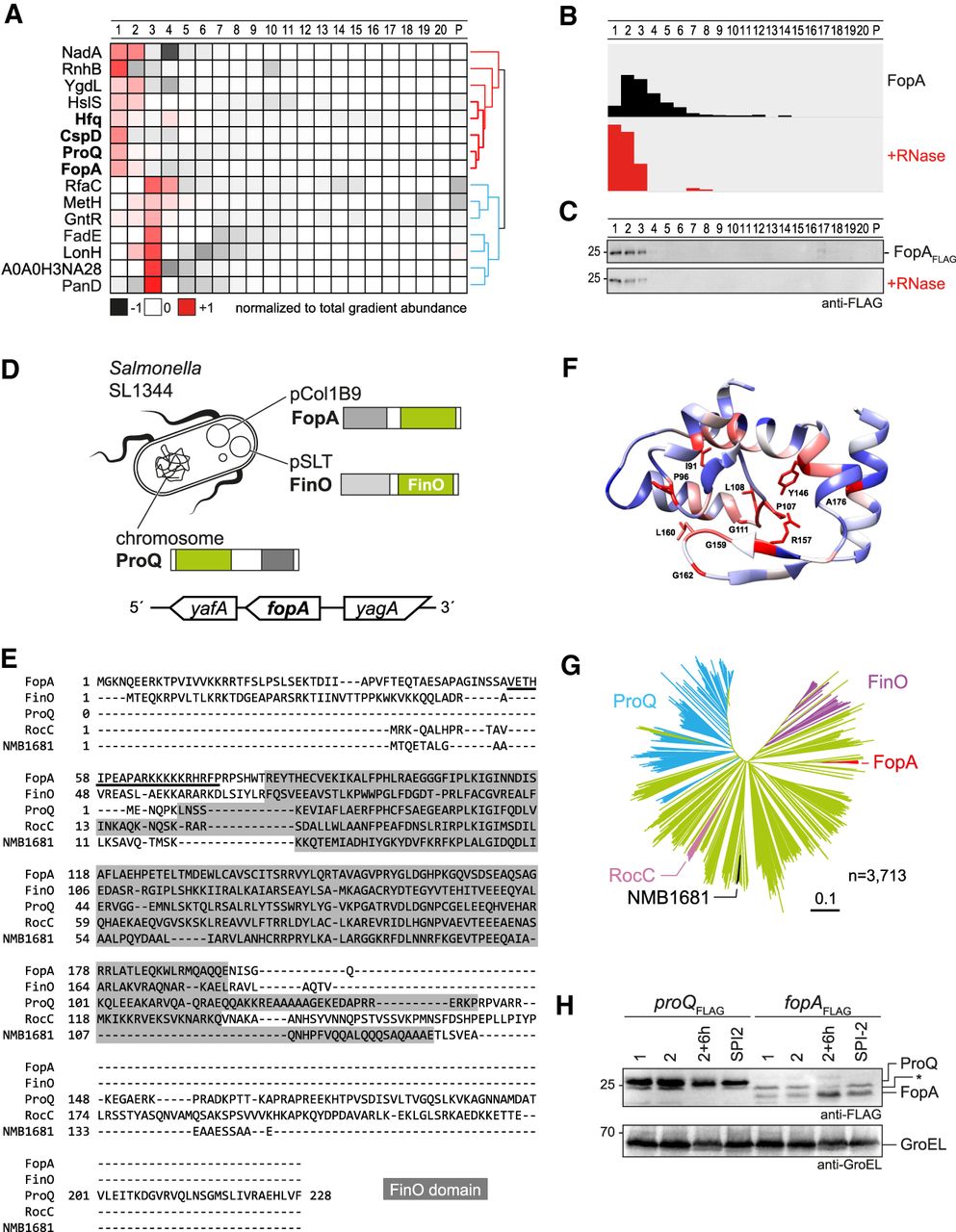
The FinO-domain protein FopA is abundant with a unique amino-terminal domain. (A) Hierarchical clustering of candidates that shifted to LMW and reduced distribution (Fig. 2, blue box, filtered to >40% shifting protein fraction) resulted in clustering of Hfq, ProQ, CspD, and the RBP candidate FopA in the red cluster. In the blue cluster, proteins shifted toward fraction 3. (B) The MS quantification of FopA showed a similar sedimentation shift as for ProQ, which was confirmed by western blot analysis (C). (D) Salmonella harbors three FinO-domain proteins. ProQ is encoded on the chromosome whereas FinO and FopA are encoded on plasmids. (E) FopA homologs show a unique amino-terminal domain that is different to the FinO amino-terminal domain. The central FinO domain in FopA (PF04352, gray background) shows conserved key residues. (F) Homology model of the FinO domain of FopA with color-coded conservation (red indicates high conservation). (G) FopA proteins represent a distinct branch (red) in a phylogenetic analysis based on protein sequences of 2569 FinO-domain containing proteins (PF04352, Pfam 32.0, Clustal Omega analysis). (H) FopA levels are strongly elevated at late stationary phase and increased in SPI-2-inducing conditions. (*) Anti-body cross-reaction.




