


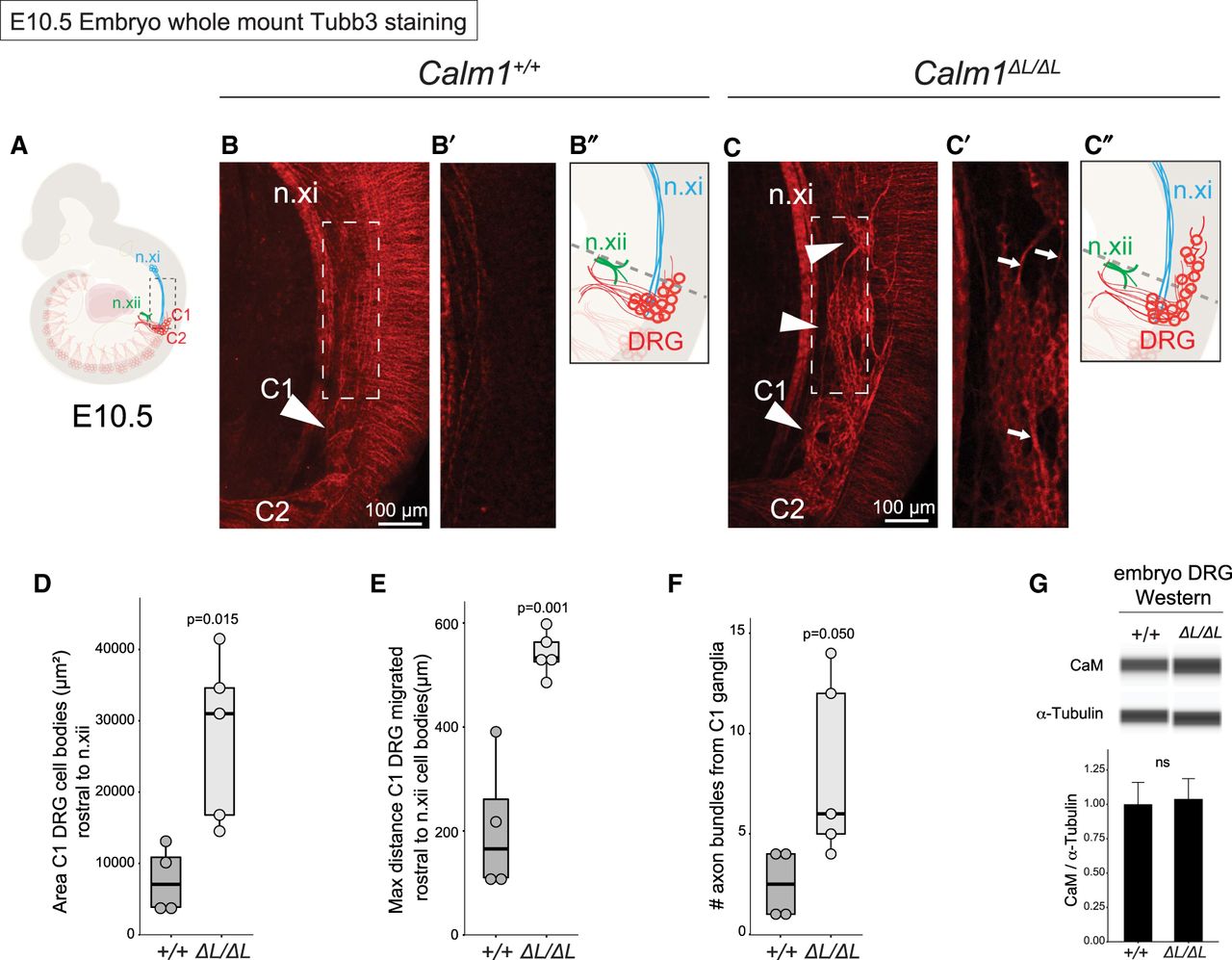
Calm1ΔL/ΔL mice exhibit DRG axon development defects. Developing C1 DRG exhibit axonal and cell body migration disorganization in Calm1ΔL/ΔL E10.5 embryos. (A) Schematic of Calm1+/+ E10.5 embryo highlighting the morphology of the C1 and C2 DRG axons and cell bodies. (B,C) Whole mount Calm1+/+ and Calm1ΔL/ΔL DRG morphology visualized by anti-Tubb3 labeling. (B) The cell bodies of the C1 DRG (arrowhead) in Calm1+/+ embryos are bundled together to form a distinct ganglion. The neurites of the C2 DRG can be seen projecting ventrally in an organized bundle. (C) The C1 DRG in Calm1ΔL/ΔL animals is disorganized and consists of clusters of cell bodies (arrowheads) that extend bundles of axons (arrows). The C1 DRG cells of deletion animals migrate rostral relative to Calm1+/+ and are adjacent to the n.xi tract (B′,C′). Enlarged view of single optical section of same Z-stack from B and C focusing on disorganized mutant cell body morphology of ganglion that aberrantly migrated more rostral relative to control. (D–F) In order to start measurements in the same relative location between embryos, n.xii was used as an anatomical landmark to set a beginning of measurements, indicated by the gray dashed lines in B″,C″. (D) Quantification of area of ectopic cell bodies observed for developing DRG. (E) Distance of aberrantly clustered cell bodies in Calm1+/+ and Calm1ΔL/ΔL. (F) Quantification of the number of axon bundles projecting off C1 ganglia. Significance determined by a t-test; n = 4 C1 DRG Calm1+/+; n = 5 C1 DRG Calm1ΔL/ΔL. n.xi = accessory nerve, n.xii = hypoglossal nerve. (G) Capillary western analysis of Calm1+/+ and Calm1ΔL/ΔL embryonic DRG showing no change in overall protein levels. Significance was determined using a t-test, P = 0.802; n = 3.




