


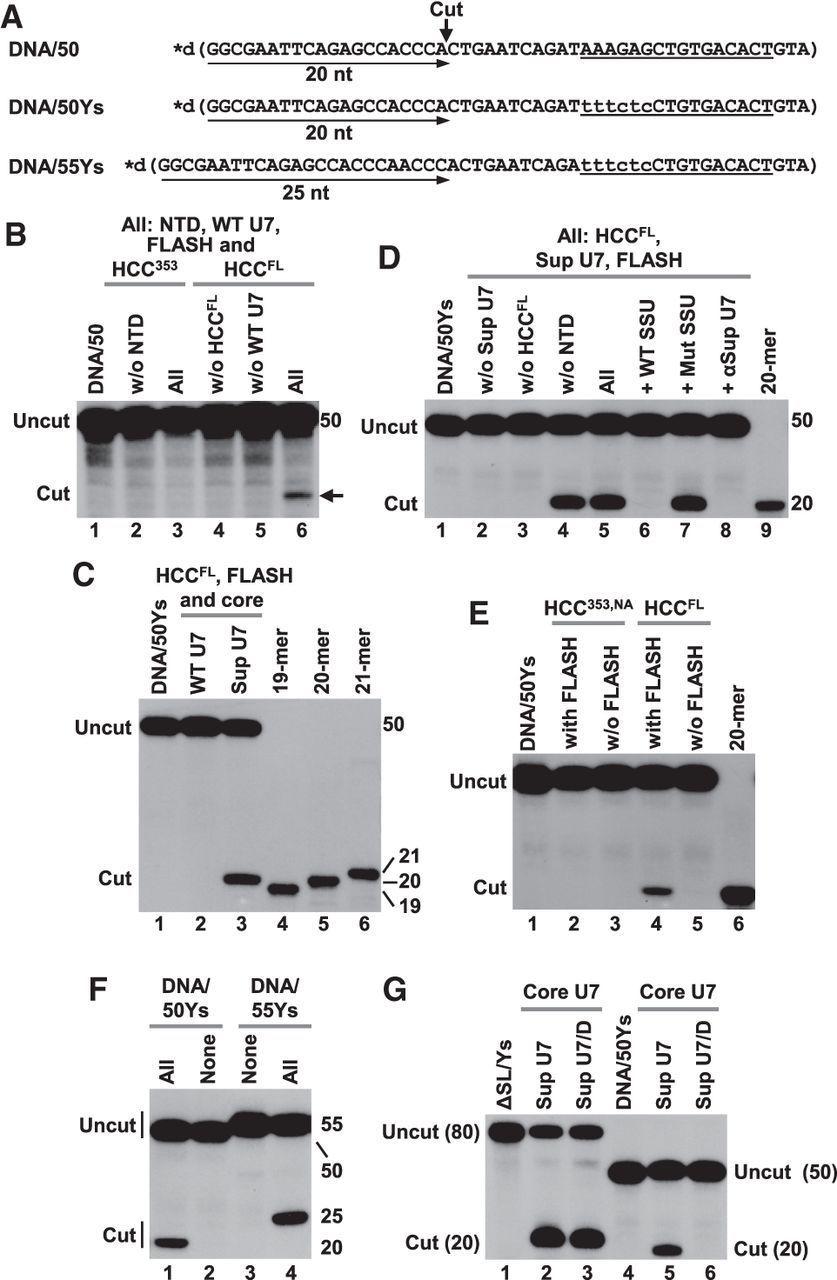
Recombinant U7 snRNP cleaves single-stranded DNA substrates. (A) Nucleotide sequence of three single-stranded DNA substrates, DNA/50, DNA/50sY, and DNA/55Ys, used in the assay. The arrows indicate expected length of products if the endonucleolytic cleavage occurs at the same site as in the RNA substrates. (B–F) Endonucleolytic cleavage of DNA/50 (panel B), DNA/50Ys (panels C–E), or DNA/55Ys (panel F) by recombinant U7 snRNP containing indicated components. The arrow in panel B indicates specific cleavage product of the expected size. (G) Cleavage of ΔSL/Ys pre-mRNA and DNA/50Ys substrates by recombinant U7 snRNPs containing either Sup U7 or Sup U7/D snRNAs. The input for each substrate is shown in lane 1 (panels B–E,G) and in lanes 2,3 (panel F). Note that the cleavage products generated from each substrate, in spite of having the same length and sequence, display slightly different electrophoretic mobility due to different chemical nature of DNA and RNA. In addition, ΔSL/Ys pre-mRNA was generated by T7 transcription, rather than by chemical synthesis, as in the case of DNA/50Ys, and it may contain an additional nucleotide at the 5′ end that would increase the length of the final product to 21 nt.




