


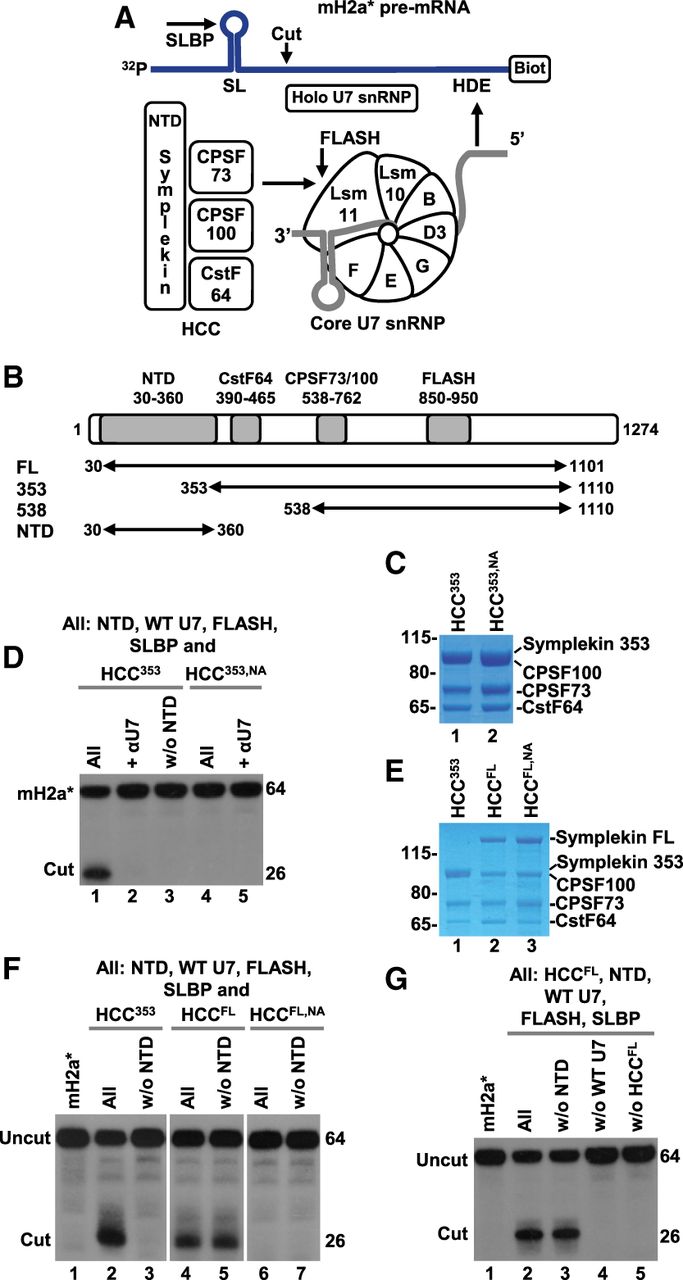
Cleavage of histone pre-mRNAs by recombinant U7 snRNP depends on the catalytic site in CPSF73 and the amino-terminal domain of symplekin. (A) Diagram depicting the assembly of U7 snRNP from recombinant components: core U7 snRNP (U7 snRNA and seven subunits of the Sm ring), FLASH, and the HCC consisting of symplekin (either lacking or containing the NTD), CPSF100, CPSF73, and CstF64. The assembled U7 snRNP was tested for the ability to cleave 5′-labeled 64-nt mH2a* pre-mRNA in the presence of SLBP. (B) Schematic representation of various symplekin mutants incorporated into the HCC. Shaded areas indicate the NTD and binding sites for other components of U7 snRNP. (C) Subunits of the indicated HCC variants were separated by electrophoresis in a 4%–12% SDS/polyacrylamide gel and visualized by staining with Coomassie blue. The HCC353 contains symplekin that begins with amino acid 353 and hence lacks the NTD; CPSF73 is wild type. The HCC353,NA additionally contains D75N/H76A mutation in CPSF73. Note that the truncated symplekin and CPSF100 form a single band under these electrophoretic conditions. (D) Recombinant U7 snRNP containing indicated components was tested in the presence of SLBP (together referred to as “All”) for cleavage of mH2a* pre-mRNA labeled at the 5′ end with 32P. The reaction generates 26-nt upstream cleavage product (cut) that contains the 5′ label and was visualized by autoradiography. The downstream cleavage product lacks the label and is not visible. (E–G) As in panels C,D, with the exception that symplekin in HCCFL begins with amino acid 30, thus contains the NTD. The input pre-mRNA prior to incubation with recombinant U7 snRNP is shown in lane 1 of panels F and G.




