


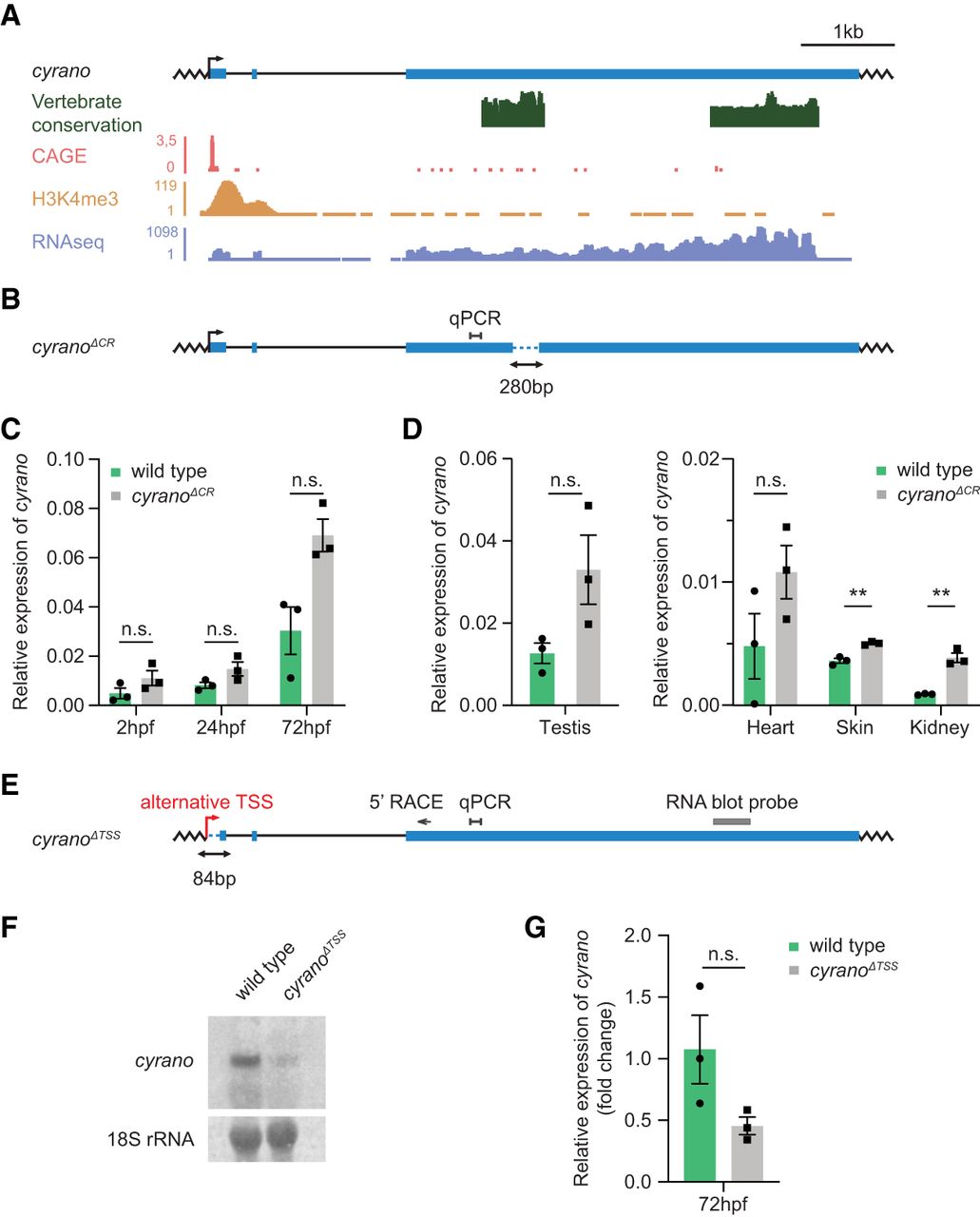
Genetic perturbations of the lncRNA cyrano in zebrafish result in overexpression and hypomorphic alleles. (A) Gene architecture of the lncRNA cyrano. Shown are the corresponding CAGE (Nepal et al. 2013; Haberle et al. 2014), H3K4me3 ChIP-Seq (Ulitsky et al. 2011), and RNA-seq tracks from wild-type (WT) zebrafish. Vertebrate conservation plots based on the eight-genome alignment indicate the location of conserved sequences. (B) The cyranoΔCR mutant allele showing the deletion of the most conserved region of the transcript (dotted, blue line) in zebrafish. Position of the qRT-PCR product is indicated. (C) cyrano expression in WT and homozygous cyranoΔCR embryos detected by qRT-PCR at 2 h postfertilization (hpf), 24 and 72 hpf. (D) cyrano expression across WT and homozygous cyranoΔCR adult tissues detected by qRT-PCR. (E) The cyranoΔTSS zebrafish allele showing deletion of the sequence around the TSS (dotted, blue line). Indicated are positions of the 5′ RACE primer, qPCR product, RNA blot probe and alternative TSS. (F) cyrano expression in 72 hpf WT and homozygous cyranoΔTSS embryos detected by an RNA blot. 18S rRNA was used as a reference gene. (G) cyrano expression in 72 hpf WT and homozygous cyranoΔTSS embryos detected by qRT-PCR. eef1α1l1 was used as a reference gene in all qRT-PCR experiments. Each dot represents an individual biological replicate. Data are presented as mean ± S.E.M.; (*) P < 0.05, n.s., not significant, unpaired t-tests.




