


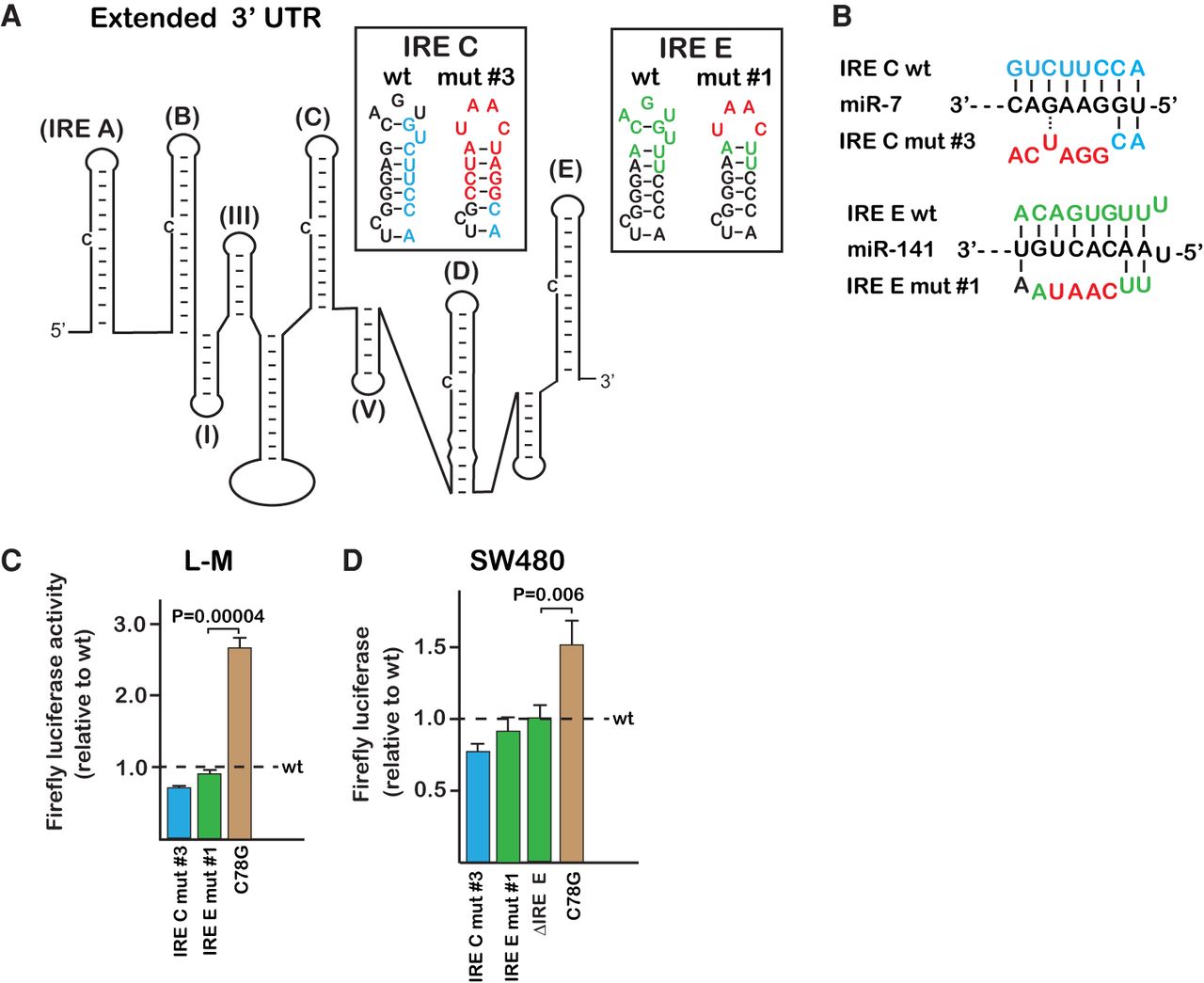
The proposed miR-7-5p and miR-141-3p binding sites are not functional within the context of an extended 3′-UTR from TfR1. (A) Approximately 700 nt of the TfR1 3′-UTR, containing all five IREs (nt 3445–4135 in NM_003234.3), was cloned behind a firefly luciferase reporter. Insets indicate the predicted secondary structures of IRE C and IRE E resulting from the mutations (red) used to disrupt the proposed miR-7-5p (blue) and miR-141-3p (green) binding sites. (B) The interactions of miR-7-5p and miR-141-3p with their proposed binding sites should be disrupted by the indicated mutations. (C) The expression of the reporter mRNA within L-M cells was not increased by disruption of either proposed microRNA binding site. A point change within stem–loop III is shown for comparison (brown); this mutation is within the context of the extended 3′-UTR but numbering corresponds to C78G in Figure 1A. (D) Mutation of the proposed microRNA binding sites failed to increase the luciferase within the SW480 cells. The ΔIRE E deletion (nt 4017–4045 in NM_003234.3), which includes the entire proposed microRNA binding site, also had no impact. Luciferase was measured after 14 h treatment with FAC. All error bars represent ±SEM of three biological replicates.




