


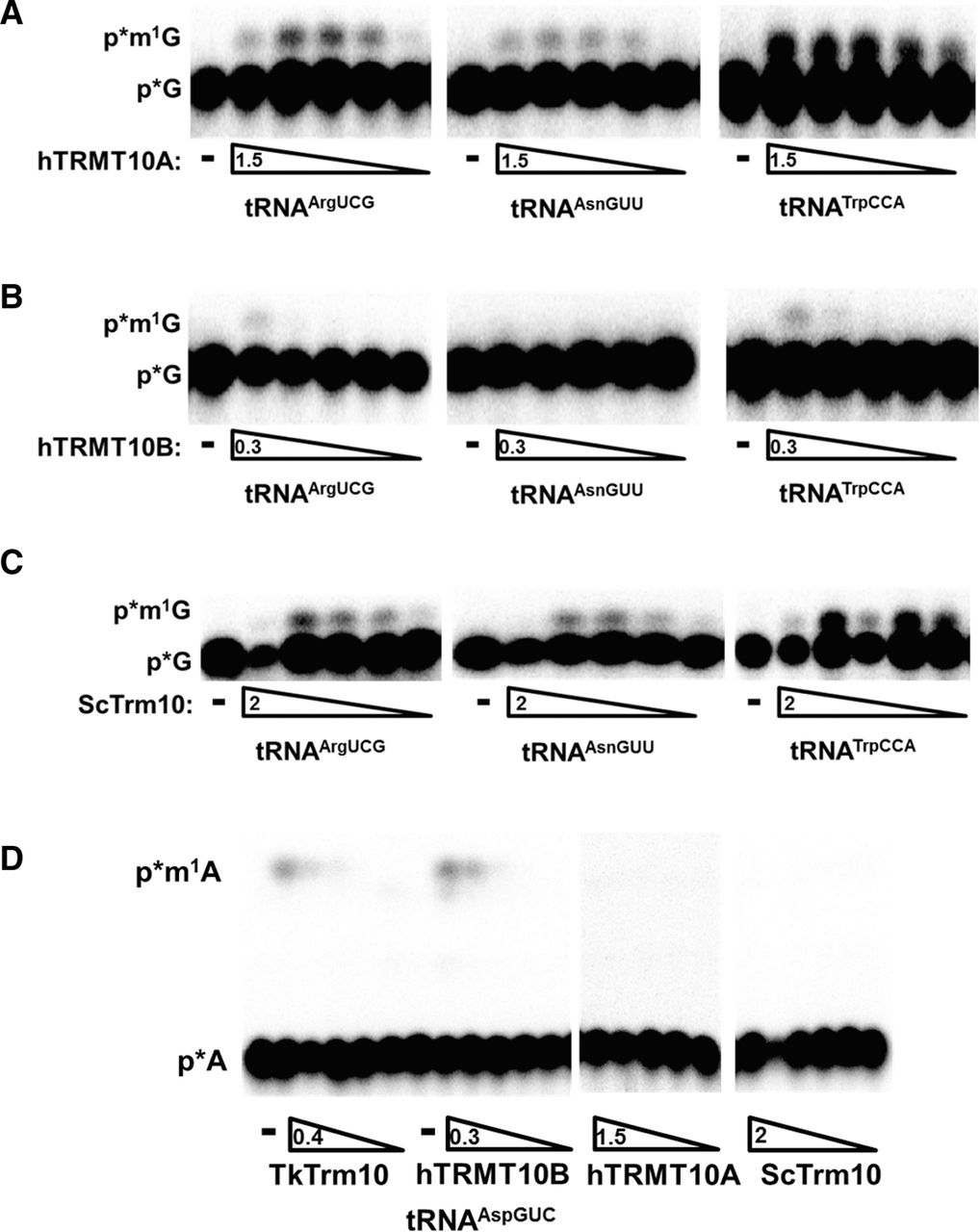
Human TRMT10A and TRMT10B exhibit distinct in vitro tRNA substrate specificities. (A) m1G9 activity of hTRMT10A on human G9-containing tRNAs. Labeled tRNA were created by in vitro transcription in the presence of [α32P]-GTP, resulting in uniform labeling at every G nucleotide. Labeled tRNA were incubated with fivefold dilutions of the enzyme (1.5 mg/mL to 2.4 µg/mL, with the highest concentration indicated by the number shown in the wedge representing each titration) or no enzyme (−) for 1 h. Quenched reactions were digested to single nucleotides using P1 nuclease and analyzed by TLC to resolve product (p*m1G) from remaining unreacted substrate (p*G). (B) m1G9 activity of hTRMT10B on human G9-containing tRNAs. Reactions were performed identically to A, except that serial dilutions contained 0.3 mg/mL to 0.5 µg/mL enzymes, with the highest concentration indicated by the number shown in the wedge representing each titration as above. (C) m1G9 activity of ScTrm10 on human G9-containing tRNAs. Reactions were performed identically to A, except that serial dilutions contained 2 mg/mL to 3 µg/mL enzyme, with highest concentration indicated by the number shown in the wedge representing each titration as above. (D) m1A9 activity of hTRMT10A and hTRMT10B, and T. kodakarensis Trm10 positive m1A9 control (Krishnamohan et al. 2019), on human tRNAAsp. Uniformly A-labeled in vitro transcript of tRNAAsp was prepared as described in B above (in transcription reactions containing [α32P]-ATP), and tested with the same assay. Digestion with nuclease P1 generates p*m1A from methylated product RNA and p*A from unreacted substrate, which are also resolved by TLC.




