


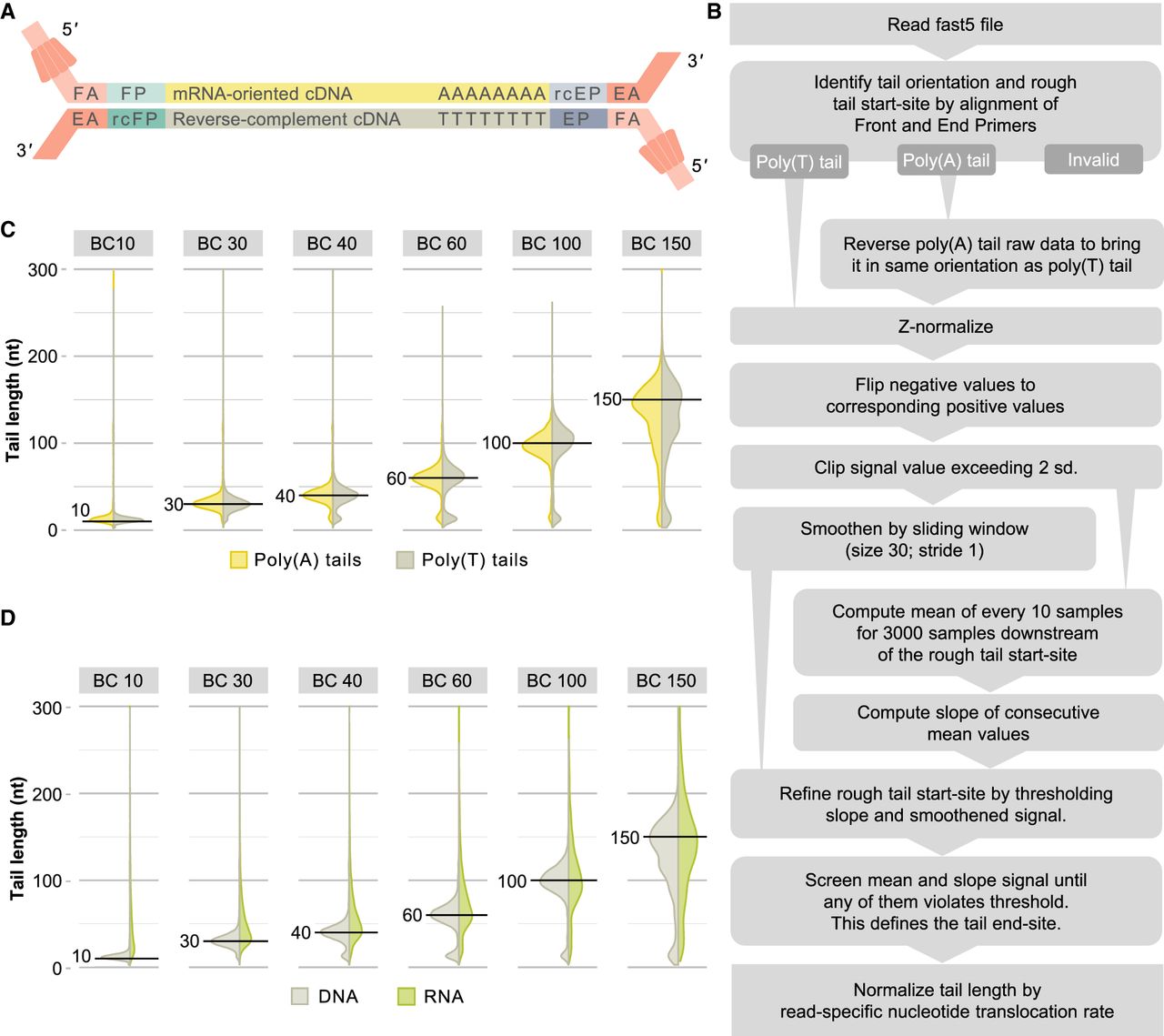
Workflow and performance of tailfindr on ONT DNA sequencing data. (A) Schematic representation of Oxford Nanopore DNA sequencing. In cDNA approaches, amplification is ensured by oligo-dT-aided anchoring of the end primer (EP, blue) and addition of front primer sequence (FP, light green) by template switching during reverse transcription. The motor protein (red) is attached to the double-stranded DNA molecules at both ends by T4 DNA ligation. The front adapter (FA) bears the motor protein, while the end adapter (EA) is a short complementary oligo that will ultimately appear at the 3′-end of resulting sequences. Both DNA strands are sequenced from 5′ to 3′. Thus, oligo-dT stretches will be present at the beginning of raw data, while oligo-dA stretches appear at the end. (B) Schematic workflow for ONT DNA sequencing data processing by the tailfindr algorithm. (C) Vertical density plot of poly(A) (yellow) and poly(T) (gray) length estimates on PCR-amplified eGFP coding sequence with known poly(A) length. Horizontal black lines demarcate expected poly(A) length for individual barcodes (from left to right: 10, 30, 40, 60, 100, and 150 nt labeled as BC10, BC30, BC40, BC60, BC100, BC150, respectively). (D) Vertical density plot of poly(A)/(T) length estimates on DNA sequences (gray) and poly(A) length estimates on RNA (light green) (from left to right: 10, 30, 40, 60, 100, and 150 nt labeled as BC10, BC30, BC40, BC60, BC100, BC150, respectively).




