


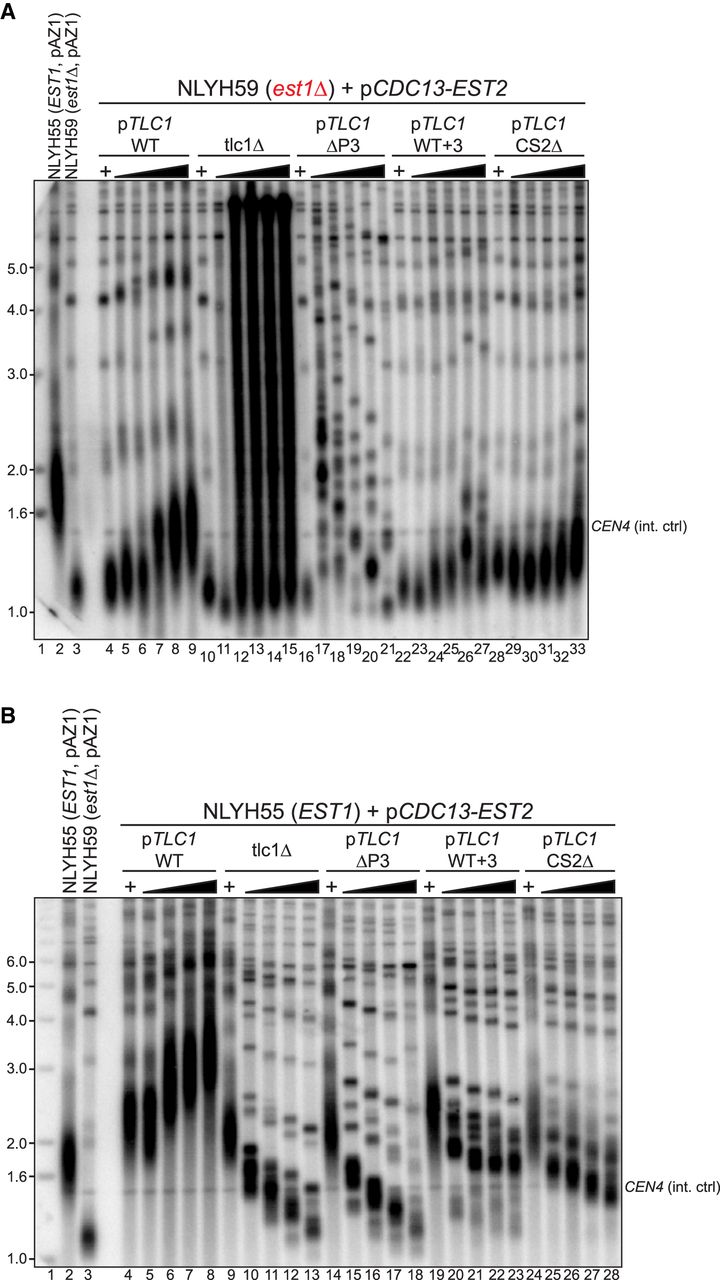
The P3 domain is necessary for Est1-independent telomerase activity in vivo. (A) Telomere length analyses on DNA from est1Δ-cells expressing the CDC13–EST2 fusion protein. Cells from the NLYH59 strain containing the indicated TLC1 alleles (lanes 4–9 and 16–33) or in the absence of TLC1 (lanes 10–15) were grown either with a WT copy of TLC1 (pAZ1, + lanes) or for 110, 210, 310, 410, and 510 generations (black triangles) without TLC1 (no pAZ1 plasmid). Lane 1 contains radiolabeled 1 kb+ DNA ladder (MW in kb). (Lanes 2–3) Control strains bearing a WT copy of TLC1 (pAZ1) and the CDC13–EST2-expressing plasmid. The blot was hybridized to a telomere-specific probe (pCT300) and a CEN4-specific probe as internal control. (B) Telomere length analyses on DNA from EST1wt-cells also expressing the CDC13–EST2 fusion protein. Cells from the NLYH55 strain containing the indicated TLC1 alleles (lanes 4–8, 14–28) or in absence of TLC1 (lanes 9–13) were grown either with a WT copy of TLC1 (pAZ1, + lanes) or for 50, 110, 150, and 210 generations (black triangles). (Lanes 2–3) Control strains bearing a WT copy of TLC1 (pAZ1) and the CDC13–EST2-expressing plasmid. (Lane 1) 1 kb+ DNA ladder (MW in kb). Blot was hybridized as in A.




