


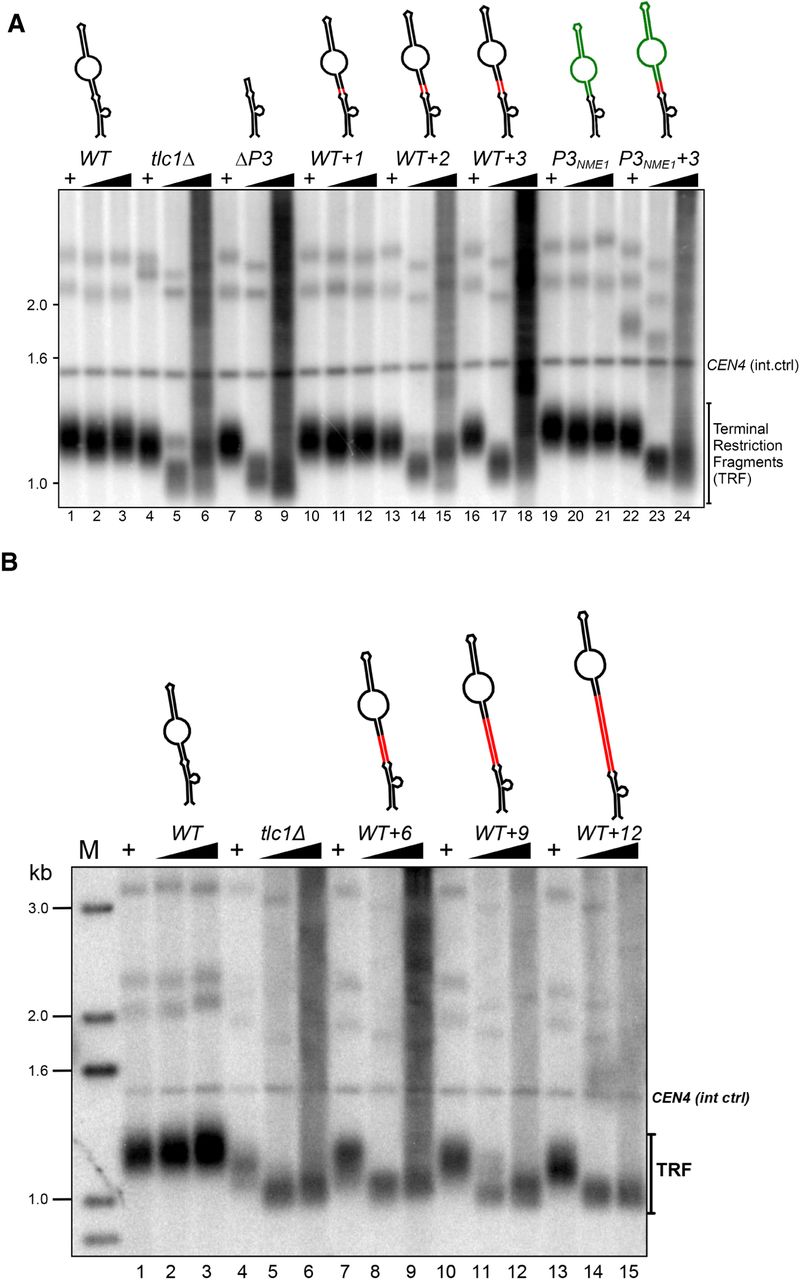
The P3-like domain and the CS2 bulge form a tightly organized binding module. (A) Telomere length analyses in EBYH03 harboring the indicated TLC1 alleles. Lanes 1–3: WT; lanes 4–6: tlc1Δ; lanes 7–9: tlc1-ΔP3; lanes 10–12: tlc1-[WT + 1]; lanes 13–15: tlc1-[WT + 2]; lanes 16–18: tlc1-[WT + 3]; lanes 19–21: tlc1-P3NME1; lanes 22–24: tlc1-P3NME1 + 3. Schematics of stem IVc structures are represented on top. Red lines indicate the site of nucleotide insertions. Green lines represent the NME1 stem–loop replacement within TLC1. (+) Strains carried a WT TLC1 gene on a URA3 plasmid. (Black triangles) Growth of cells after loss of the WT TLC1 gene for 30 and 110 generations. The blot was hybridized with telomere- and CEN4-specific probes. (B) Same telomere length analyses as in A, except that longer insertions as indicated were analyzed (lanes 7–9: tlc1-[WT + 6]; lanes 10–12: tlc1-[WT + 9]; and lanes 13–15: tlc1-[WT + 12]). Lanes with a “+” as well as the WT (lanes 1–3) and tlc1Δ (lanes 4–6) are as described above for A.




