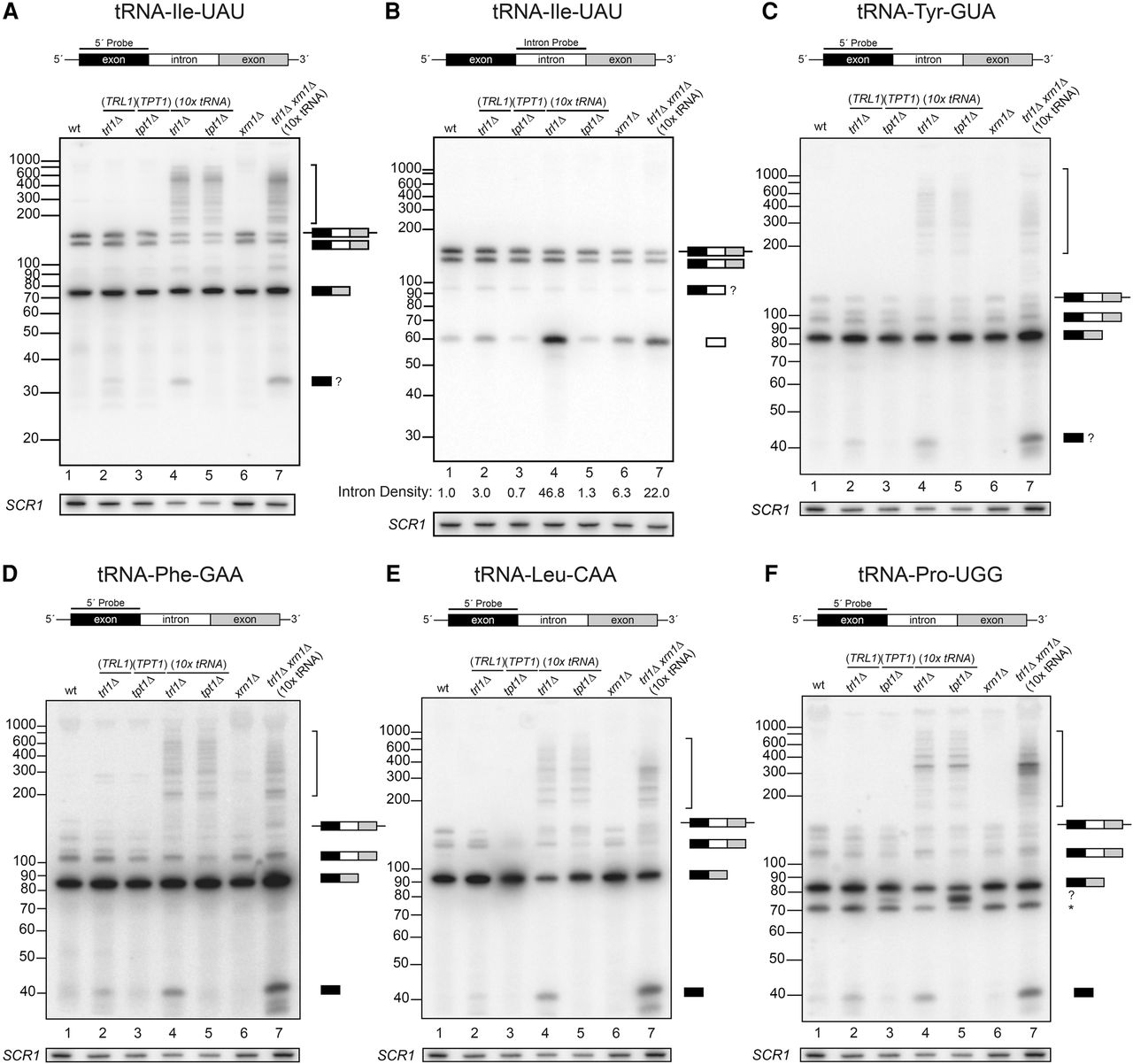
tRNA processing phenotypes of RNA repair mutants. Diagrams of tRNA primary structure, annotations, and probe locations are depicted next to each northern blot. SCR1 loading control blots are below, and were the basis of loading for each lane. (A) Northern blot using probe that hybridizes to the 5′-exon of tRNAIle(UAU) identifies preprocessed tRNA intermediates derived from primary transcripts of intronless tRNAs (lanes 4,5, and 7, bracket annotation), as well as intermediates arising from the intron-containing endogenous tRNAs (at ∼150 nt). Each strain produces mature tRNAs (∼76 nt). The trl1Δ mutant (lane 4) is unable to ligate tRNAIle(UAU) exons arising from chromosomal copies of the gene, and thus mature tRNAs in these cells occur from processing of the intronless tRNA transcript. A band at ∼32 nt in lanes 4 and 7 is likely a product of SEN cleavage of chromosomally encoded intron-containing tRNAs that are not re-ligated. (B) Northern blot with probe to tRNAIle(UAU) intron shows increased accumulation of the intron in trl1Δ mutants (lanes 4 and 7), as well as in xrn1Δ and in double deletion trl1Δ xrn1Δ mutants (lanes 6 and 7, respectively). A band at ∼90 nt putatively represents 5′-exon/intron (question mark). Densitometry quantifications of intron signal relative to wild-type (lane 1) and normalized to SCR1 signal are displayed below lane numbers. (C) Northern blot with probe to the 5′-exon of tRNATyr(GUA), a tRNA with a copy number of eight in the budding yeast genome, reveals mature tRNA bands at approximately the same intensity across wild-type (lane 1) and repair mutant strains (lanes 4 and 5). (D) Northern blot with probe to the 5′-exon of tRNAPhe(GAA), a tRNA with a copy number of 10 in the genome, exhibits approximately equal density of mature tRNA band intensity in wild-type (lane 1) and deletions in RNA repair genes (lanes 4 and 5). (E) Northern blot with probe to the 5′-exon of tRNALeu(CAA), a tRNA with a copy number of 10 in the genome, shows a decrease in mature tRNA band intensity in the trl1Δ mutant (lane 4), and also in the tpt1Δ mutant (lane 5), when compared to wild-type and covered strains (lanes 1–3). (F) Northern blot with probe to the 5′-exon of tRNAPro(UGG), a tRNA with a copy number of 10 in the genome, reveals a decrease in mature tRNA band intensity in both trl1Δ and tpt1Δ RNA repair mutants (lanes 4 and 5, respectively). All lanes show a doublet of bands, with the upper band being consistent in size with mature tRNAPro(UGG), and the lower band is annotated with an asterisk. Lane 5 displays a strong tpt1Δ-dependent band, annotated with a question mark.