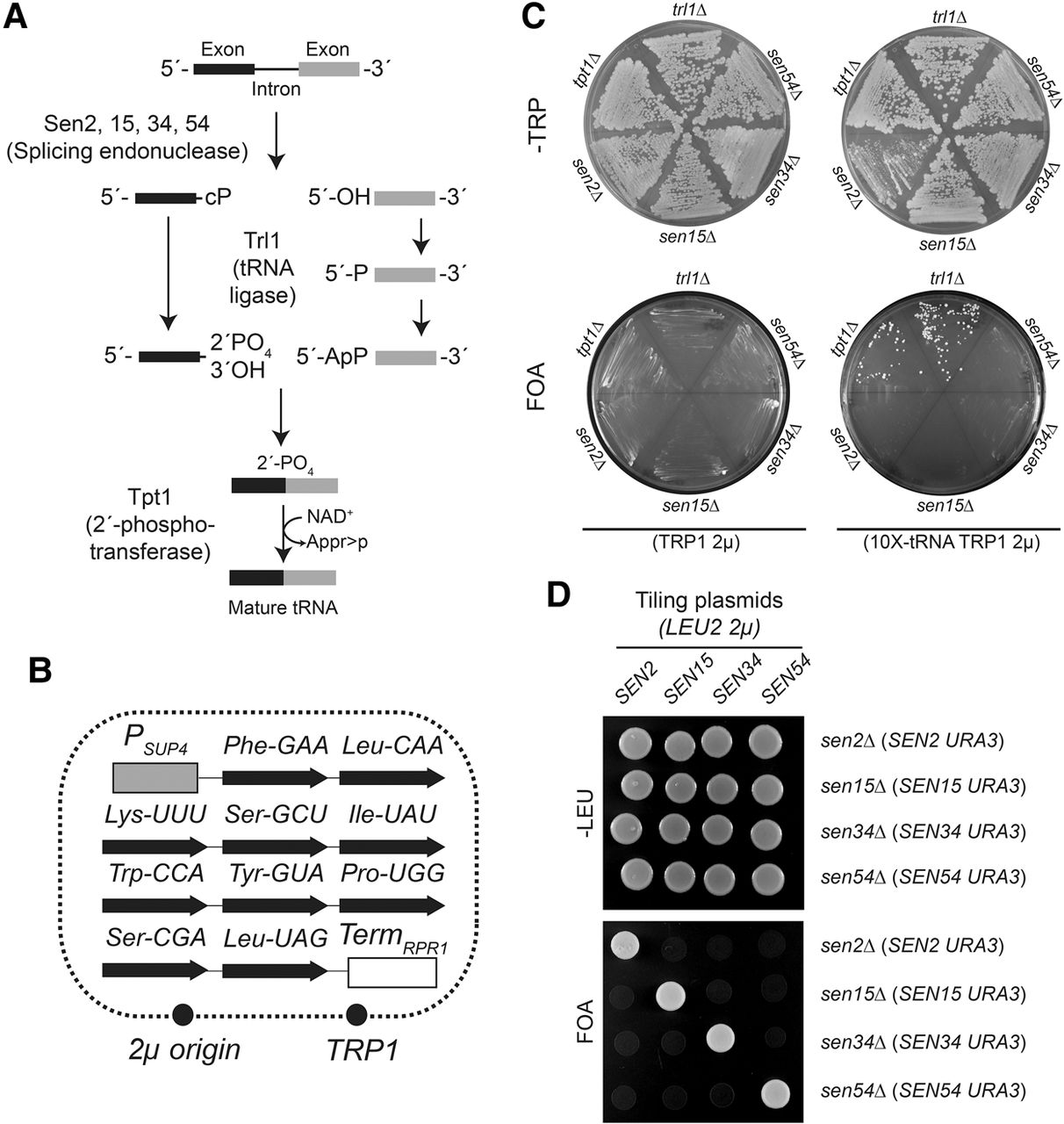
Genetic bypass of essential components of tRNA splicing with intronless tRNAs. (A) Functions of tRNA splicing enzymes. Introns from pre-tRNAs are removed by the SEN complex, which contains the Sen2 and Sen34 endonucleases that cleave the 5′ and 3′ splice sites, respectively, as well as Sen15 and Sen54. Following cleavage, the tRNA exons are ligated by the multifunctional RNA ligase Trl1, producing a ligated tRNA with a 2′-phosphate at the splice junction. Tpt1 removes the 2′-phosphate in an NAD+-dependent reaction, producing ADP-ribose-1″,2″ cyclic phosphate and nicotinamide. (B) Schematic of a plasmid encoding the 10 S. cerevisiae tRNAs in intronless form. The tRNAs are expressed from a high-copy 2µ TRP1 plasmid containing a SUP4 promoter and terminated by the RPR1 terminator. (C) Genetic bypass of RNA repair mutants by expression of intronless tRNAs (“10×-tRNA” plasmid). Strains expressing a URA3 covering plasmid were transformed with an empty vector (TRP1 2µ) or a high-copy plasmid encoding intronless tRNAs (B). URA+ TRP+ colonies (top row) were selected and struck on FOA media (bottom row), which selects against cells with the covering plasmid, to assess intronless tRNA-mediated bypass. Plates were photographed after 5–7 d of incubation at 30°C. Intronless tRNAs complement deletion of TRL1 and TPT1 but do not rescue deletion of SEN components (bottom right). (D) Cells with genomic deletions of SEN genes (SEN2, SEN15, SEN34, SEN54) and a single-copy URA3 plasmid expressing the deleted gene were individually transformed with high-copy LEU2 plasmids containing the genomic locus of each of the SEN genes. LEU+ colonies were plated on −LEU media (top), and FOA media (bottom), to select against the covering plasmid. Only those plasmids that contain the cognate genomic locus of the deleted SEN gene were able to rescue growth on FOA (bottom).