


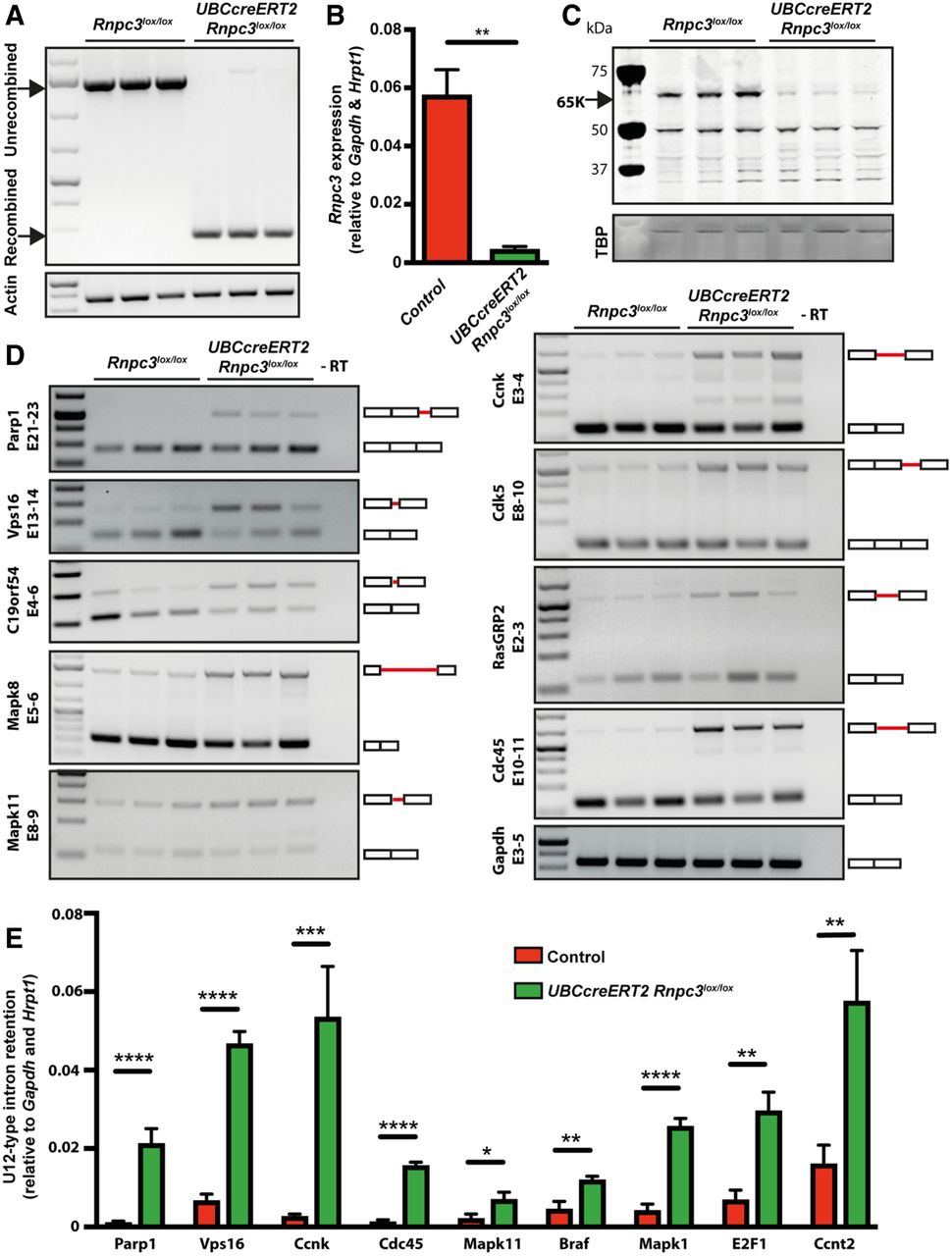
Loss of 65K impairs minor class splicing in colonic epithelial cells. Preparations of gDNA, total RNA, and protein were extracted from purified colon crypt epithelial cells 4 d post-tamoxifen treatment. (A) Allele-specific PCR-based analysis demonstrates almost complete recombination of the Rnpc3 locus in UBC-CreERT2;Rnpc3lox/lox samples, but not in Rnpc3lox/lox samples. (B) RT-qPCR confirms that rnpc3 mRNA levels are significantly reduced in UBC-CreERT2;Rnpc3lox/lox samples (green bars) compared to control (red bars; combination of tamoxifen treated UBC-CreERT2;Rnpc3+/+ and Rnpc3lox/lox samples). (C) Western blot analysis shows a marked reduction in 65K protein in UBC-CreERT2;Rnpc3lox/lox compared to Rnpc3lox/lox controls (relative to TBP loading control). (D) RT-PCR and gel electrophoresis analysis of U12-type intron containing genes in colon crypt epithelial cells of mice shown in A. Schematic representation of spliced and intron-retaining mRNAs is shown on the right, with retained U12-type introns represented by red solid lines between exons (white boxes). (E) RT-qPCR using primers designed to amplify transcripts retaining their U12-type intron in several candidate U12-type intron-containing genes (Parp1, Vps16, Ccnk, Cdc45, Mapk11, Braf, Mapk1, E2F1, and Ccnt2) shows that U12-type intron retention is significantly increased in recombined UBC-CreERT2;Rnpc3lox/lox samples (green bars) compared to controls (red bars; combination of tamoxifen-treated UBC-CreERT2;Rnpc3+/+ and Rnpc3lox/lox samples). Data are expressed as mean + SEM relative to expression of housekeeping genes Gapdh and Hrpt1; n = 3 for each genotype. (*) P < 0.05, (**) P < 0.01, (***) P < 0.001, (****) P < 0.0001 Student's t-test.




