


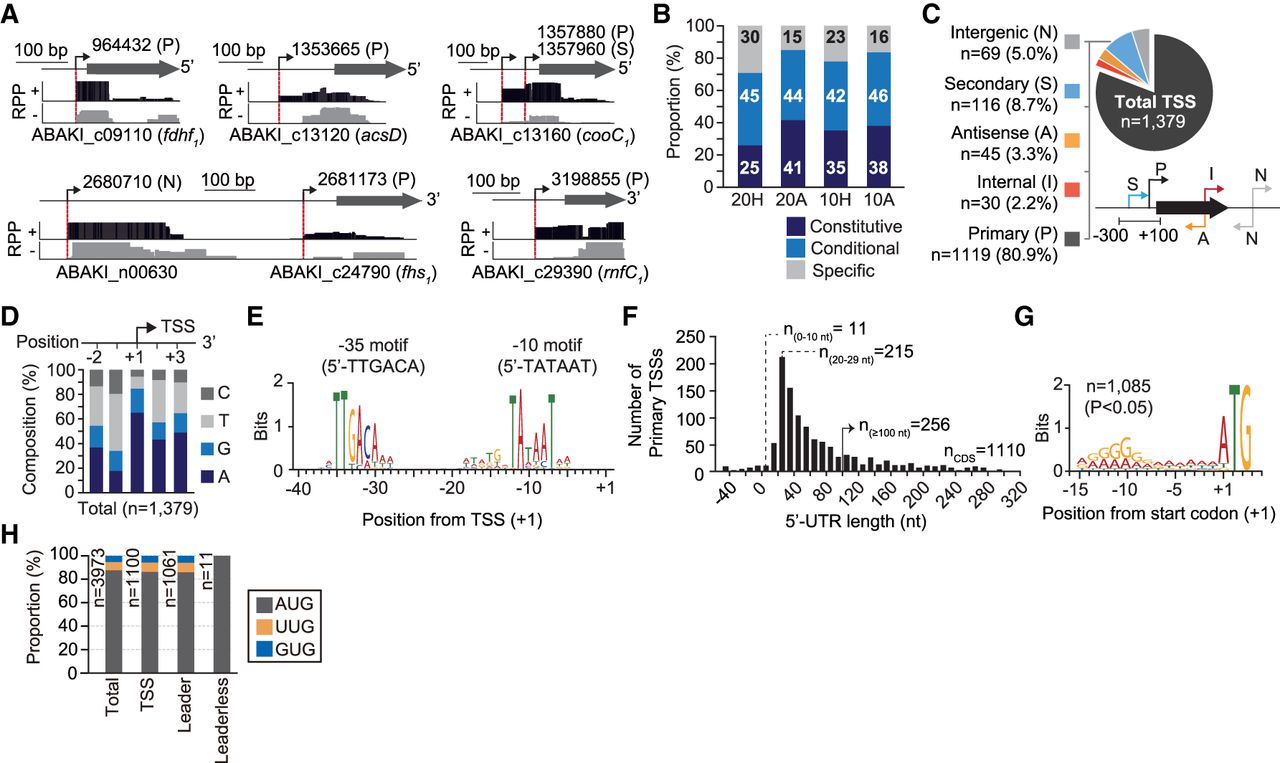
The transcription architecture of the A. bakii DSM 8239 genome. (A) Examples of dRNA-seq profiles mapped onto the A. bakii genome. Complementary DNA (cDNA) reads mapped to genome from RNA 5′-pyrophosphatase-treated (RPP+) and -untreated (RPP−) libraries are shown to represent the genomic regions. A red bar indicates the position of transcription initiation, which is identified by enriched 5′-ends of aligned dRNA-seq reads in RPP+ libraries (two biological duplicates) and nonenriched 5′-end reads of aligned dRNA-seq reads in RPP− libraries. See also Supplemental Figure S4A. (B) The proportion of constitutive (shared by all conditions), conditional (existing in two or more conditions), and specific (unique to a single condition) TSSs across the four conditions. (C) Categorization of 1379 TSSs identified in all samples. Primary TSSs (P) have a maximum peak density within a distance <300 bp upstream and 100 bp downstream from annotated genes; secondary TSSs (S) are associated with the same ORF as a nearby primary TSS but have lower peak density; internal TSSs (I) are located on the same strand as an annotation; antisense TSSs (A) are located on the opposite strand as an annotation; and intergenic TSSs (N) are those not falling into any of the above-mentioned categories. See Supplemental Table S6 for all TSS information and noncoding RNA lists, respectively. (D) Distribution of each nucleotide around the TSS (+1). (E) Motif searches upstream of A. bakii TSSs for all TSSs. See also Supplemental Figure S5. (F) Distribution of the 5′-UTR lengths of primary TSSs. (G) Conserved AG-rich Shine-Dalgarno (SD) sequences for 1085 protein-coding transcripts. (H) The frequency of start codons of all 3973 ORFs, 1100 TSS-assigned ORFs, 1061 ORFs containing 5′-UTRs (leader sequence), and 11 leaderless ORFs.




