


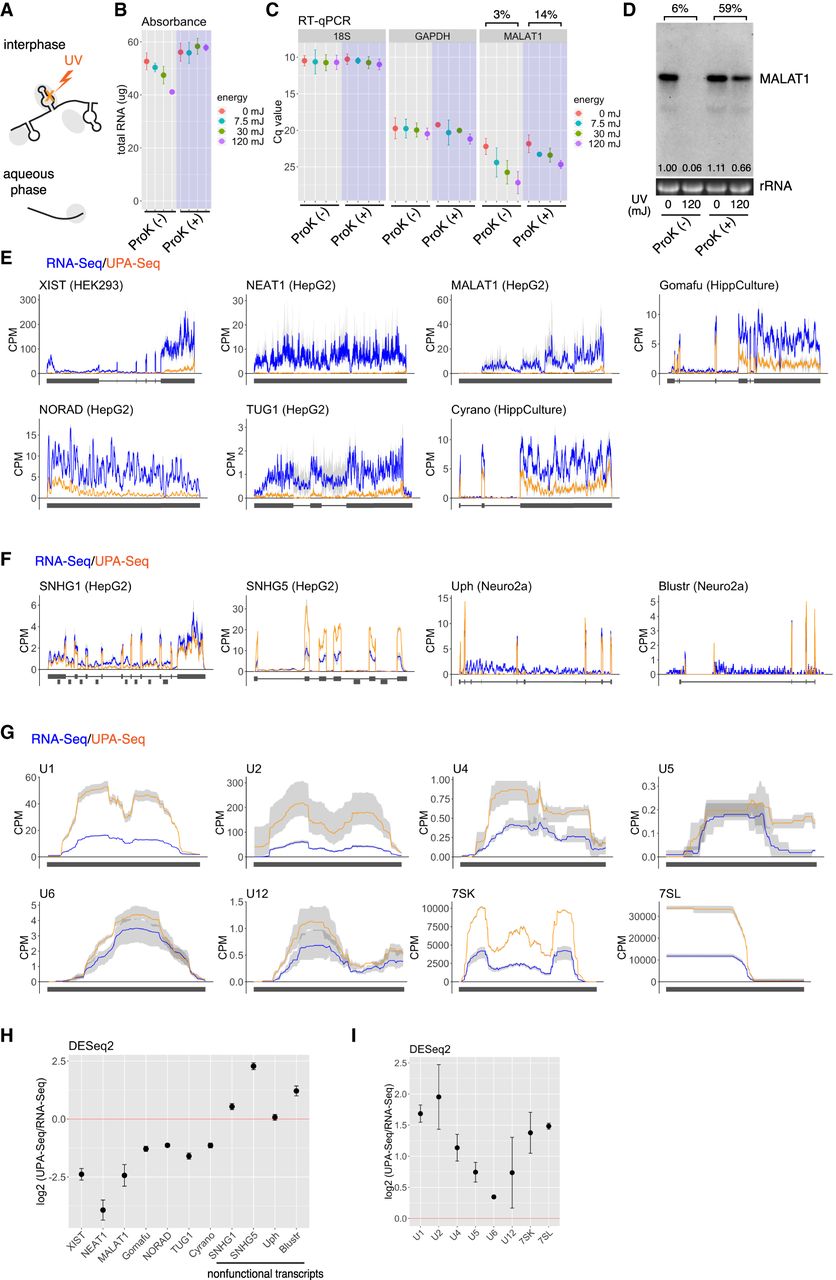
Reduced recovery of known functional lncRNAs from the aqueous phase upon UV irradiation. (A) Schematic drawings of the principle of UPA-seq. UV irradiation introduces crosslinking between RNA (black lines) and proteins (gray ovals), and crosslinked complexes are separated into the interphase after phenol-chloroform extraction. (B) The amount of total RNA (µg) recovered from the aqueous phase upon different doses of UV irradiation (0, 7.5, 30, and 120 mJ/cm2) with or without pretreatment with proteinase K [ProK(+)/ProK(−)]. Data are presented as the means ± SD of three biological triplicates. 18S: 18S ribosomal RNA. (C) RT-qPCR quantification of RNA transcripts recovered from the aqueous phase upon different doses of UV irradiation (0, 7.5, 30, and 120 mJ/cm2) with or without pretreatment with proteinase K [ProK(+)/ProK(−)]. The Cq values of the representative functional lncRNA MALAT1 are increased upon UV irradiation, which was partially restored by the proteinase K pretreatment. Data are presented as the mean ± SD of five biological replicates except for the 7.5 mJ condition, which is presented as biological duplicates. Note that the scale Y is reversed. Fold change upon UV irradiation at 120 mJ (3%, 14%) was calculated by 2−ΔCq. (D) Northern blot analyses of MALAT1 recovered from the aqueous phase upon UV irradiation (120 mJ/cm2) with or without pretreatment with proteinase K [ProK(+)/ ProK(−)]. The numbers in the blot area indicate the relative expression quantified by ImageJ. (E) Distribution of UPA-seq and RNA-seq reads mapped to representative functional lncRNAs. Blue and orange lines represent the distribution of reads obtained by UPA-seq and RNA-seq, respectively. Cell types used for the analysis are indicated by the name of the lncRNA genes. (F) Distribution of UPA-seq and RNA-seq reads mapped to lncRNAs, of which transcribed products are thought to be nonfunctional. (G) Distribution of UPA-seq and RNA-seq reads mapped to classic ncRNAs. (H) Log2 fold change of reads obtained by UPA-seq and conventional RNA-seq mapped to lncRNAs. Sequence reads were counted by featureCount and normalized by DESeq2. Note that nonfunctional lncRNA transcripts do not exhibit decreased recovery. (I) Log2 fold change of reads mapped to classic ncRNAs upon UV irradiation. Data are presented as the means ± SD of three biological triplicates. CPM in E-G represents counts per millions of reads.




