


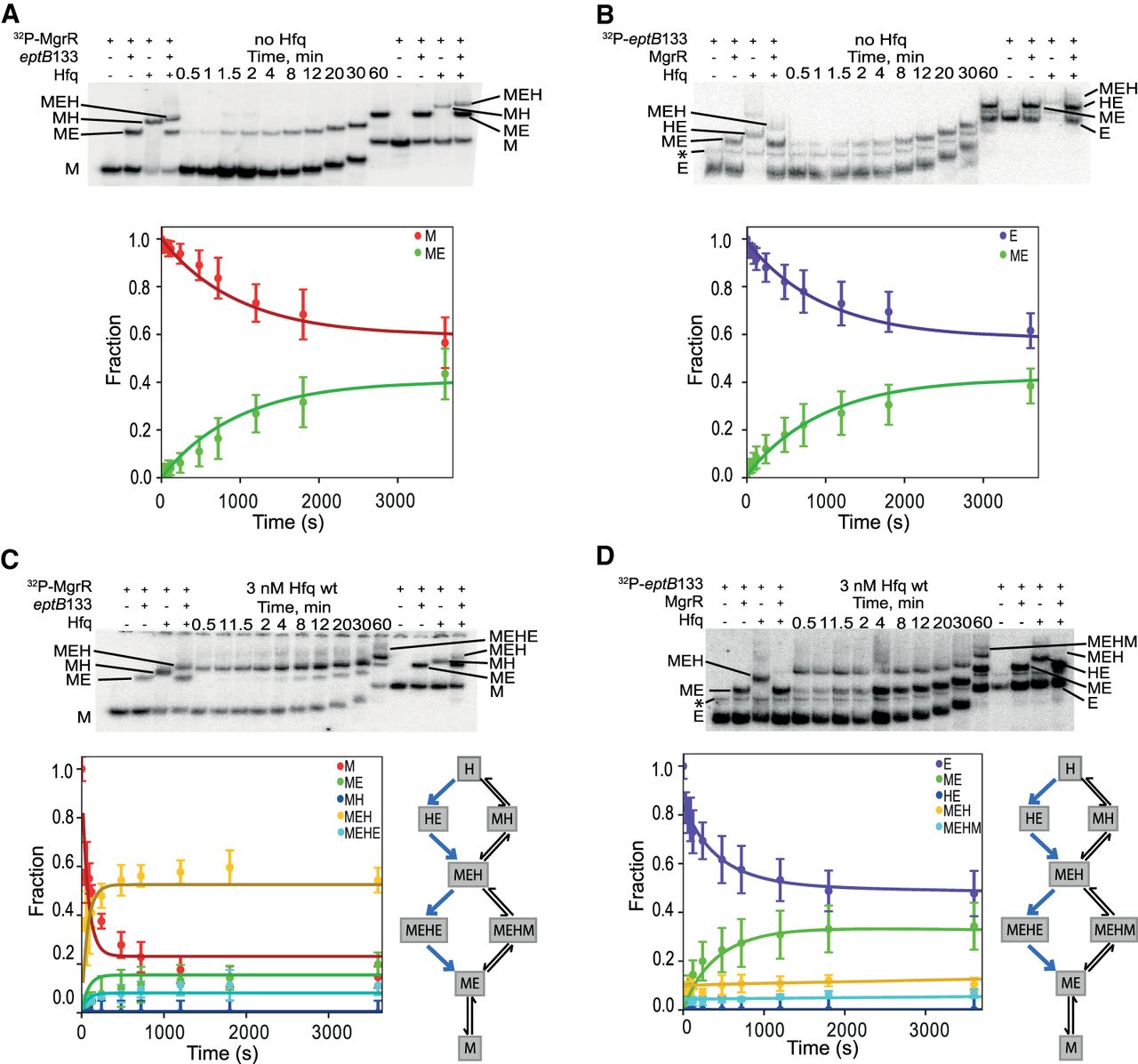
Global modeling of MgrR annealing to eptB133 in the presence of wt Hfq. The native gel analysis of the kinetics of (i) 32P-labeled MgrR annealing to eptB133 in the absence of Hfq (A) or the presence of Hfq (C), and (ii) 32P-labeled eptB133 annealing to MgrR in the absence of Hfq (B) or the presence of wt Hfq (D). The data from A, B, C, and D were analyzed globally, and the lines in the plots are the results of global fitting. The schemes on the right of the plots in C and D describe kinetically preferred competing pathways (blue arrows) based on the data from Table 4. Unbound MgrR is marked as M, unbound eptB133 as E, MgrR-eptB133 complex as ME, MgrR-Hfq complex as MH, eptB133-Hfq complex as HE, and MgrR-eptB133-Hfq ternary complex as MEH. MEHE and MEHM denote quaternary complexes formed in excess of unlabeled eptB133 or MgrR, respectively. The asterisk indicates a slower migrating band, which is interpreted as the dimeric form of 32P-eptB133.




