


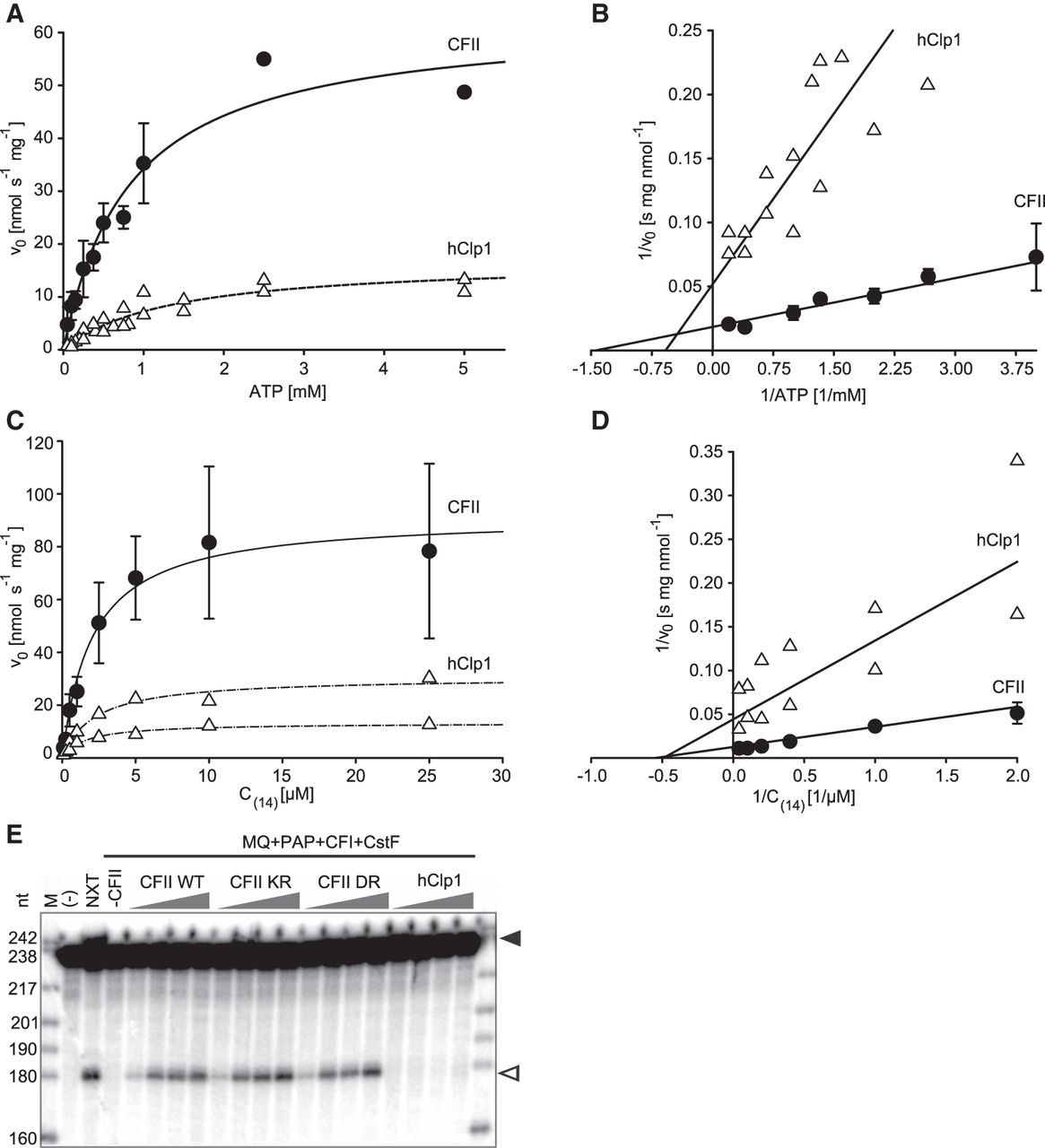
CF II has RNA 5′ kinase activity, which is not required for RNA cleavage. (A) Initial velocities of the 5′ kinase activities of CF II or hClp1 were measured at varying concentrations of [γ-32P]-ATP and a constant concentration of C14 as described in Materials and Methods. Plots represent fits to the Michaelis–Menten equation. Data points with error bars representing the standard deviation were averaged from n ≥ 3. Titrations for hClp1 were done twice, and data from both experiments were combined into one fit. (B) Data from A are presented as a Lineweaver–Burk (double-reciprocal) plot. Fits are based on all data points, but only data for higher ATP concentrations are shown so that the intersections with the axes can be seen more easily. (C) Initial velocities of the 5′ kinase activities of CF II or hClp1 were measured at a constant concentration of [γ-32P]-ATP and varying concentrations of C14. Plots are as in A. Titrations for hClp1 were done twice and fitted separately. (D) Data from C are presented as a Lineweaver–Burk (double-reciprocal) plot. The fit for hClp1 is based on both titrations. Fits are based on all data points, but only data for higher RNA concentrations are shown so that the intersections with the axes can be seen more easily. In both ATP and RNA titrations, the apparently higher Vmax values of CF II as opposed to hClp1 have to be viewed with caution as discussed in the legend to Table 1. (E) Cleavage assays contained 5, 25, 50, or 200 fmol of hClp1 or of wild-type CF II or of CF II with clustered point mutations in the active site of hCp1 (KR: K127A, R288A, R293L; DR: D151A, R288A, R293L). These proteins were tested in a complementation system containing the SV40 late RNA, poly(A) polymerase, CF I, CstF, and a protein fraction generated from HeLa cell nuclear extract by ammonium sulfate precipitation, gel filtration, and MonoQ chromatography as described in Materials and Methods. Note that the MonoQ fraction contained less unspecific nuclease activity than the gel filtration fraction used in Figure 1D. Omission of CF II or all proteins were used as negative controls and addition of nuclear extract (NXT) as a positive control, as indicated. Black and white arrowheads indicate substrate RNA and 5′ cleavage product, respectively. Controls with a mutant RNA showed that the cleavage activities were dependent on the AAUAAA sequence (data not shown).




