


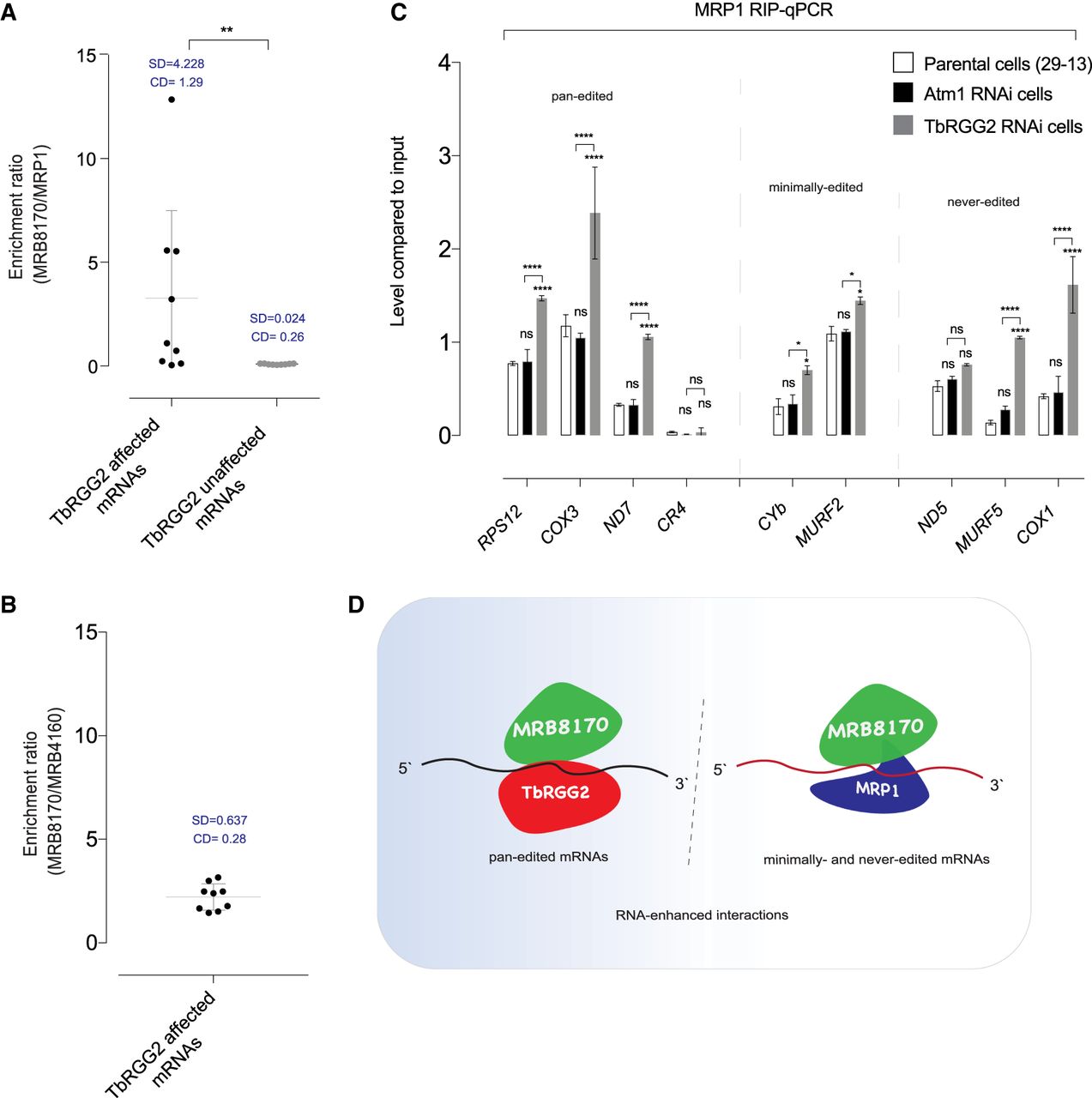
MRP1 and TbRGG2 recruited to 8170 on mRNAs in a class-specific manner. (A) Enrichment ratios of bound MRB8170 relative to bound MRP1 (y-axis) of each pan-edited, minimally edited, and never-edited mRNA. The first column includes all pan-edited mRNAs; these are affected by TbRGG2 depletion. The second column includes minimally and never-edited mRNAs; these are unaffected by TbRGG2 depletion (Mann–Whitney test; [**] P < 0.005; SD, standard deviation; CV, coefficient of variation). (B) As in A, except that the enrichment ratio compares bound MRB8170 relative to bound MRB4160. MRB4160 does not bind to never-edited mRNAs. (C) Relative amounts of MRP1 coimmunoprecipitated mRNAs in three different conditions using RIP-qPCR (Tukey's multiple comparison test, [*] P < 0.05, [***] P < 0.001, [****] P < 0.0001, biological replicates n = 2–3). Each mRNA abundance is presented relative to the abundance of the same mRNA recovered from 1% of input lysate. (D) Combinatorial interplay involving three RNA-binding proteins. In pan-edited transcripts, MRB8170 marks the pre-edited mRNAs and is followed by TbRGG2 to allow efficient progression of editing. Since TbRGG2 is nonessential for minimally and never-edited mRNAs, MRP1 with similar functional capabilities to modulate RNA–RNA interactions operates on these transcripts.




