


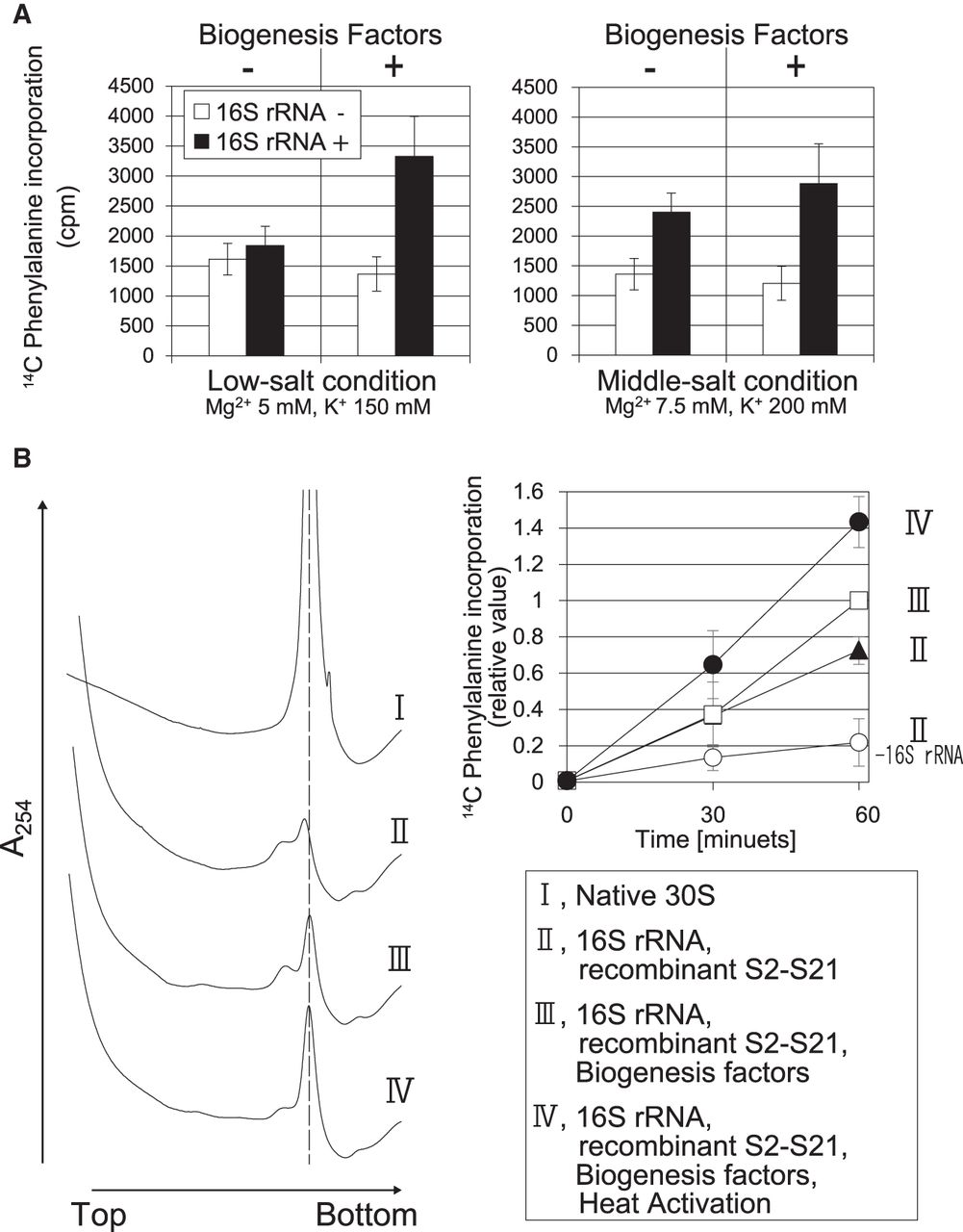
(A) 14C-phenylalanine incorporation during a 1-h period was examined using the PURE direct assay in the presence or absence of biogenesis factors. Error bars indicate standard deviations. 14C-phenylalanine incorporation in the absence of native 16S rRNA is shown by the white bar, and that with native 16S rRNA and recombinant ribosomal proteins (S2–S21) is denoted by the black bar. (B) Reconstituted 30S particles in a low-salt condition (5 mM Mg2+, 150 mM K+) were analyzed by SDG analysis (Materials and Methods). Native 30S subunits are shown in line I as a control. The profile of 30S particles reconstituted using native 16S rRNA and S1–S21 ribosomal proteins is shown as line II. The profiles of 30S particles reconstituted using native 16S rRNA, S1S21 30S subunit ribosomal proteins and biogenesis factors without and with heat activation at 42°C are shown as lines III and IV, respectively. The right graph shows the effect of heat-treatment analyzed by two-step PURE direct assay. In this experiment, the 30S subunit assembly reaction was performed for 40 min at 37°C without translation mixture, including components such as native 50S subunits, poly(U), 14C-phenylalanine and elongation factors. Subsequently, the assembly reaction was additionally performed for 20 min at 37°C (II—16S rRNA, II, III) or 42°C (IV) to analyze the effect of heat-treatment. After the assembly reaction, the level of polyphenylalanine synthesis was monitored at 30 and 60 min after the addition of the translation mixture.




