


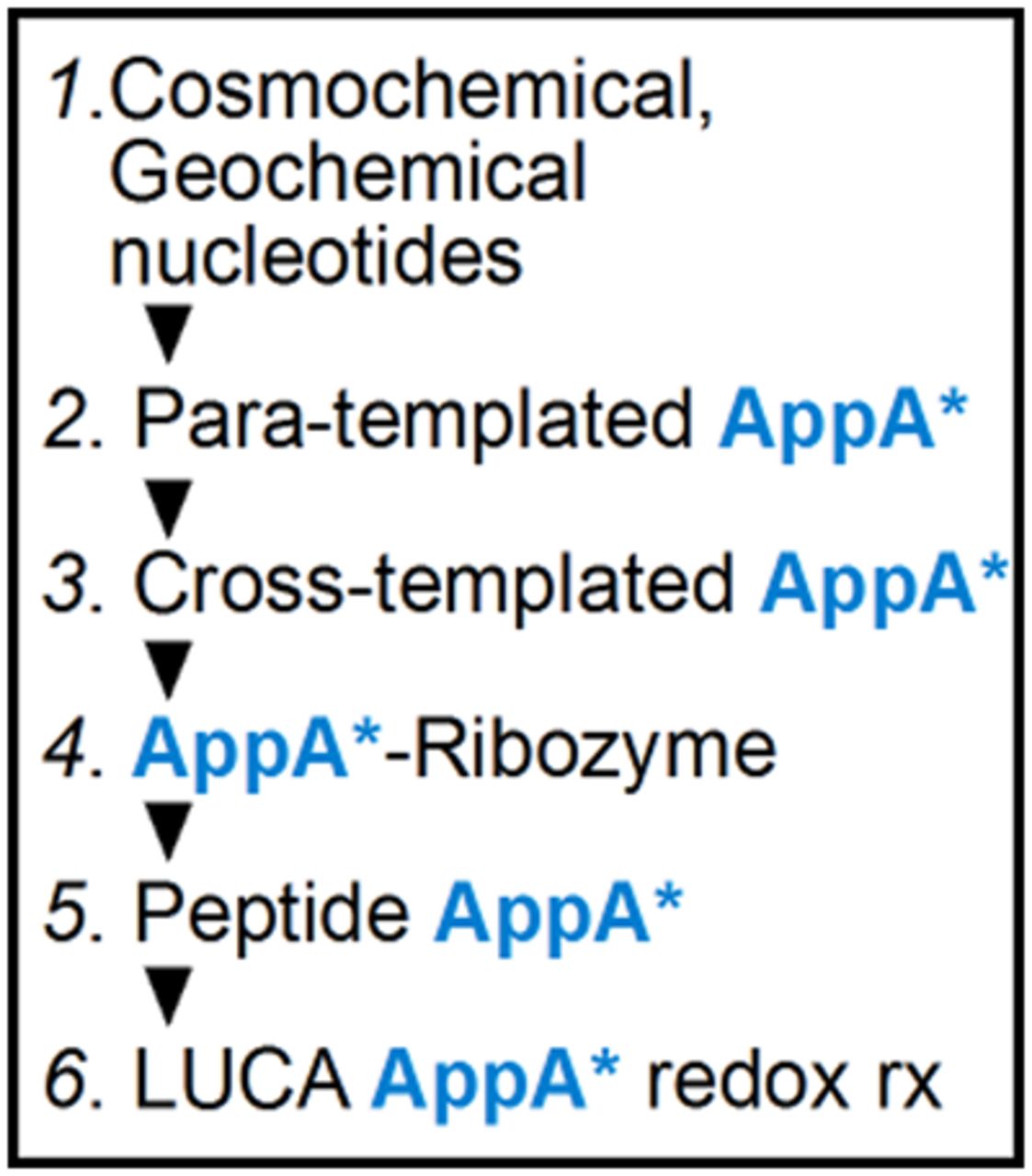
Evolutionary succession from nucleotides to a last universal common ancestor (LUCA). 1. Natural purine nucleotides (1.) initiate expression via localized para-templating of reactive dinucleotides (2.). When pyrimidine nucleotides later become available, the same product becomes more rapidly available from cross-templating (3.), still without need for complementary replication (Yarus 2017). Subsequent evolution of templated 5′–3′ RNA synthesis via base-pairing allows elaboration of an RNA world (4.) containing coenzyme-ribozymes (Jadhav and Yarus 2002). Later appearance of coded translation (Yarus 2001) creates modern peptide enzymes with bound RNA coenzymes (5.). These subsequently support a complex LUCA metabolism, whose redox reactions (6.) are particularly likely descendants of the original dinucleotides (2., see the Introduction). The coenzyme facsimile, AppA*, has been colored blue throughout the scheme to emphasize its continuous descent.




