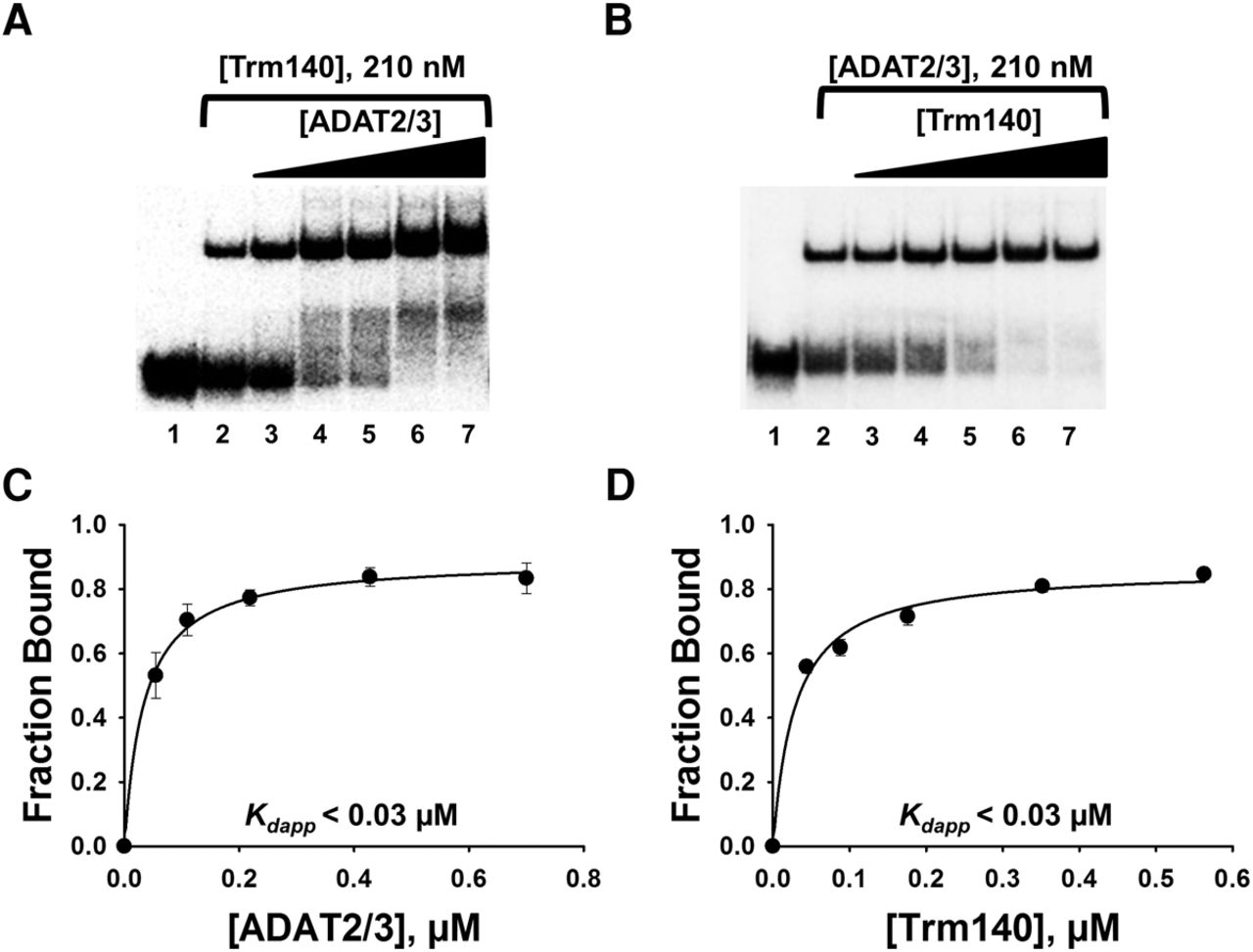
TbADAT2/3 and TbTrm140 bind tRNA synergistically. (A) EMSA of TbADAT2/3 incubated with tRNAThrCGU in the presence of a constant concentration (210 nM) of TbTrm140. Lanes 1 and 2 show a no-enzyme control reaction and a control reaction with no TbTrm140 added, respectively. Lanes 3–7 show an increasing concentration of TbADAT2/3 (0.06, 0.12, 0.24, 0.48, and 0.7 µM, respectively). (B) EMSA of TbTrm140 incubated with tRNAThrCGU in the presence of a constant concentration (210 nM) of TbADAT2/3. Lanes 1 and 2 show a no-enzyme control reaction and control reaction with no TbADAT2/3 added, respectively. Lanes 3–7 show an increasing concentration of TbTrm140 (0.04, 0.08, 0.16, 0.32, and 0.56 µM, respectively). The data were fit to a single-ligand binding isotherm and the apparent dissociation constant (Kdapp) calculated as in Figure 1. These graphs are shown in (C) and (D) for TbADAT2/3 and TbTrm140, respectively. Each figure represents at least five independent replicates.