


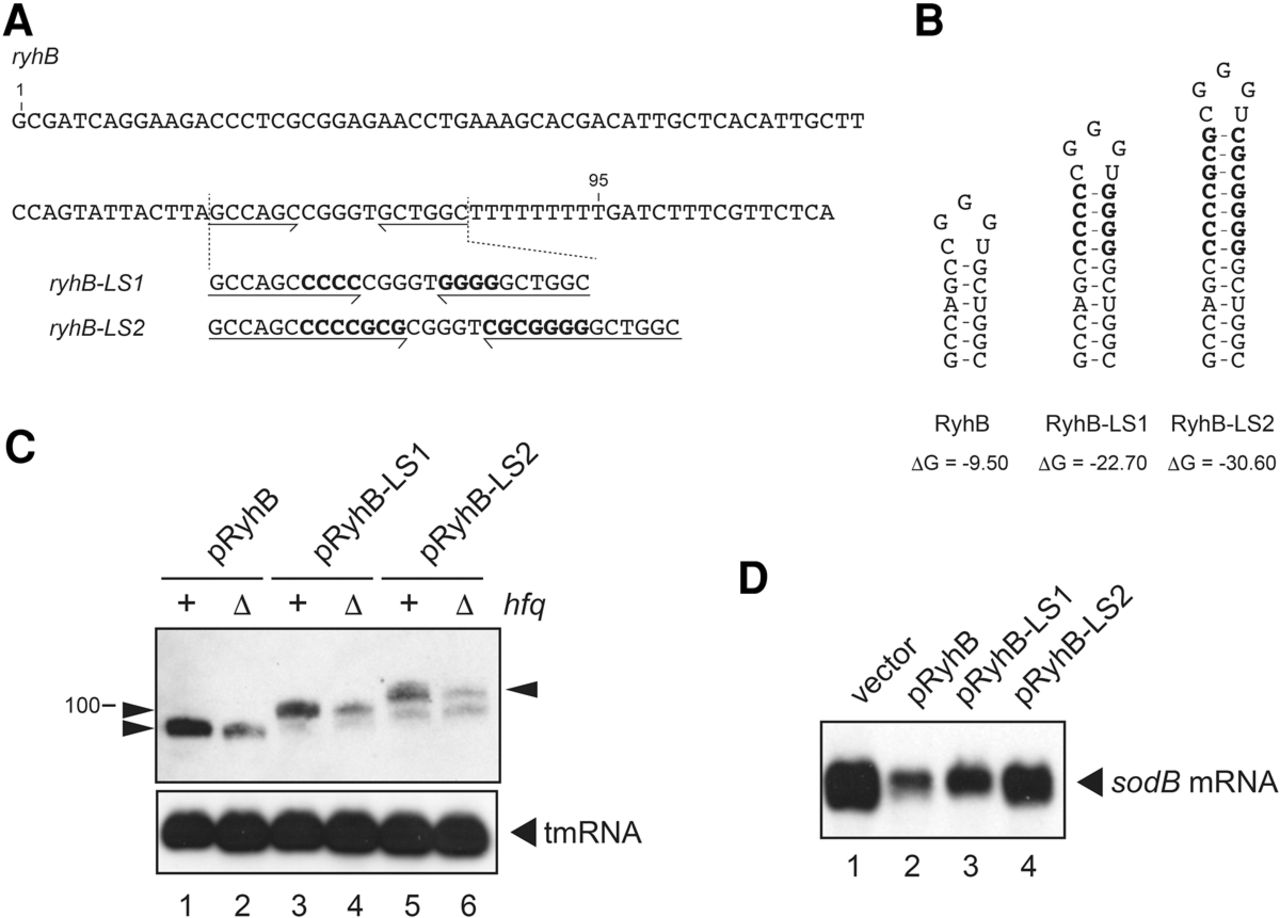
The effect of extension of the terminator stem of ryhB on transcription termination and on properties of RyhB. (A) DNA sequences of ryhB and its variants. The inverted repeat sequences of terminators are indicated by horizontal arrows. The inserted sequences to stabilize the terminator stem are shown as bold letters. Nucleotides are numbered from the site corresponding to the 5′ end of ryhB. (B) The predicted secondary structures and the thermodynamic stabilities (ΔG, kcal/mol) of RNA hairpins without the poly(U) sequence were determined according to the Mfold program (Zuker 2003). (C) Generation of heterogeneous transcripts and effect of hfq backgrounds. TM635 (ΔryhB) and TM820 (ΔryhB Δhfq) cells harboring the indicated plasmid were grown in LB medium. At A600 = 0.6, 250 µM of 2, 2′-dipyridyl was added and incubation was continued for 10 min. Then, 0.02% arabinose was added and incubation was continued for 5 min. Total RNAs were prepared, and 1.6 or 0.25 µg of RNA samples was subjected to Northern blotting using the RyhB probe and tmRNA probe, respectively. Arrowheads represent the full-length transcripts. (D) Effect of extension of the terminator stem on RyhB function. Two micrograms of RNA samples described in Figure 7C was subjected to Northern blotting using the sodB probe.




