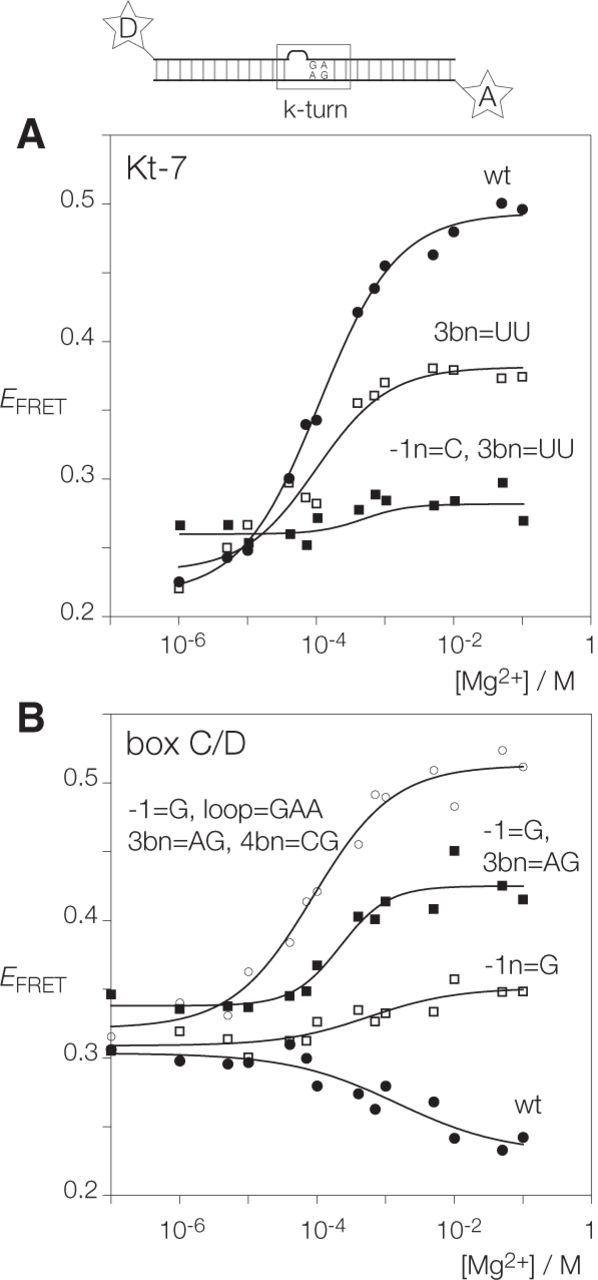
Analysis of ion-dependent folding of H. marismortui Kt-7 and A. fulgidus box C/D k-turns using FRET. The schematic (top) shows the constructs used in these studies. These are RNA duplexes with a central k-turn sequence, 5′-labeled with fluorescein donor (D) on the bulged strand and Cy-3 acceptor (A) on the nonbulged strand. The sequences are given in Materials and Methods. EFRET is plotted as a function of Mg2+ ion concentration for both constructs (points), and fitted to the two-state model (line). (A) Titration of Hm Kt-7 unmodified from the natural sequence (wt, solid circles) and two representative variants in which sequence elements have been exchanged from the box C/D k-turn. The single-change variant in which 3b:3n = U:U (open squares) and the double-change variant with 3b:3n = UU plus −1b:−1n = G:C (filled squares) are shown. (B) Titration of Af box C/D unmodified from the natural sequence (wt, solid circles) and three representative variants in which sequence elements have been exchanged from the Hm Kt-7 k-turn. The single-change variant in which −1b:−1n = C:G (open squares), the double-change variant with −1b:−1n = C:G plus 3b:3n = A:G (filled squares), and the four-change variant with −1b:−1n = C:G, loop = GAA, 3b:3n = A:G and 4b:4n = C:G (open circles) are shown. Note that the four-change variant has effectively converted Af box C/D into Hm Kt-7. Data from titration of all Hm Kt-7 and Af box C/D k-turn variants are tabulated in Table 1.