


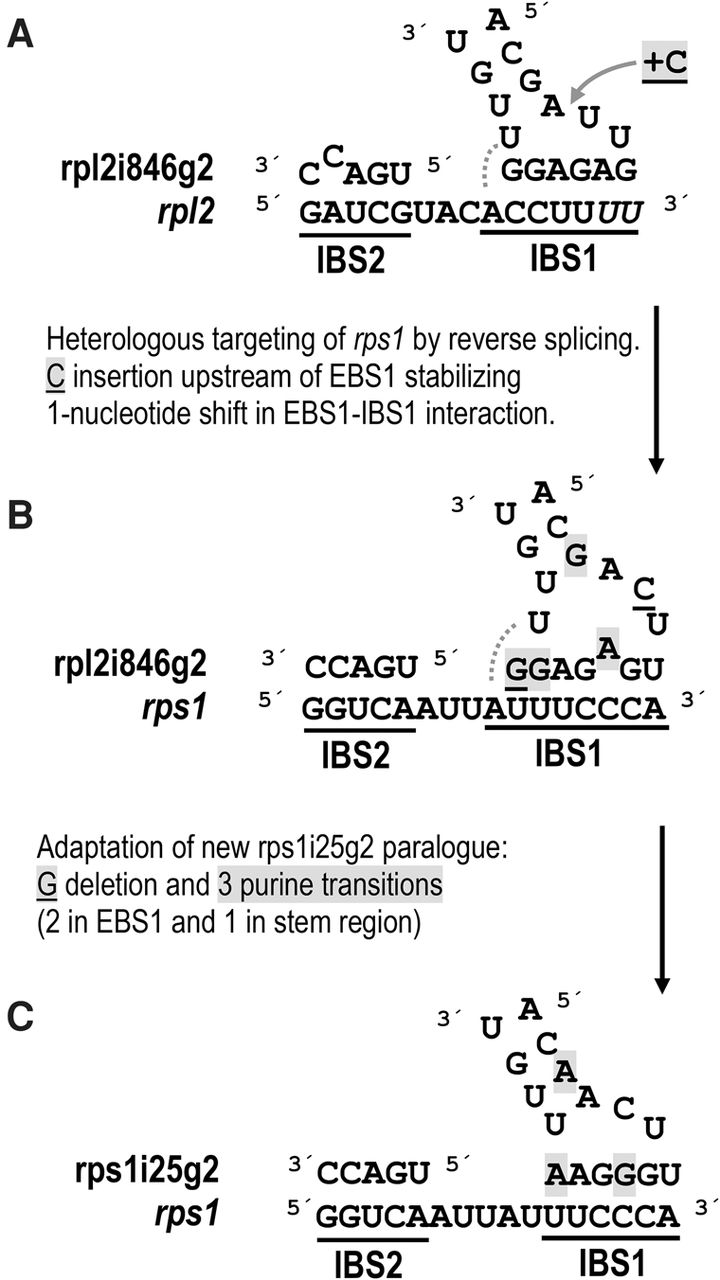
Model for an ancient retrotransposition of rpl2i846g2 into the rps1 gene creating the rps1i25g2 paralog. The transposition is mediated by permissive heterologous EBS-IBS interactions (exon/intron binding sites 1 and 2) and a subsequent adaptation of rps1i25g2 by point mutations. (A) Interaction of rpl2i846g2 EBS sequences with the orthologous rpl2 IBS sequences in the upstream exon. The two terminal positions of the upstream rpl2 exon are affected by C-to-U editing (italics). The IBS1–EBS1 interaction may be extended by a further A–U base pair at the expense of the terminal A–U base pair in the EBS1 stem (dotted line). (B) A heterologous interaction of rpl2i846g2 with the rps1 target may initially have been based on a 1-nt shift in the EBS1–IBS1 recognition subsequently stabilized by the insertion of an upstream cytidine (underlined and shaded gray under A). As in the orthologous rpl2 interaction, a further A–U base pair may extend the EBS1–IBS1 interaction at the expense of the terminal EBS1 stem base-pairing (dotted line). (C) Functional adaptation of the newly created rps1i25g2 paralog has likely been facilitated by deletion of a guanosine (gray shaded and underlined in B) to compensate for the initial upstream cytidine insertion and three purine transitions (gray shading in B and C) that stabilized the base pairings in the EBS1–IBS1 interaction and in the EBS1 stem in the course of evolution.




