


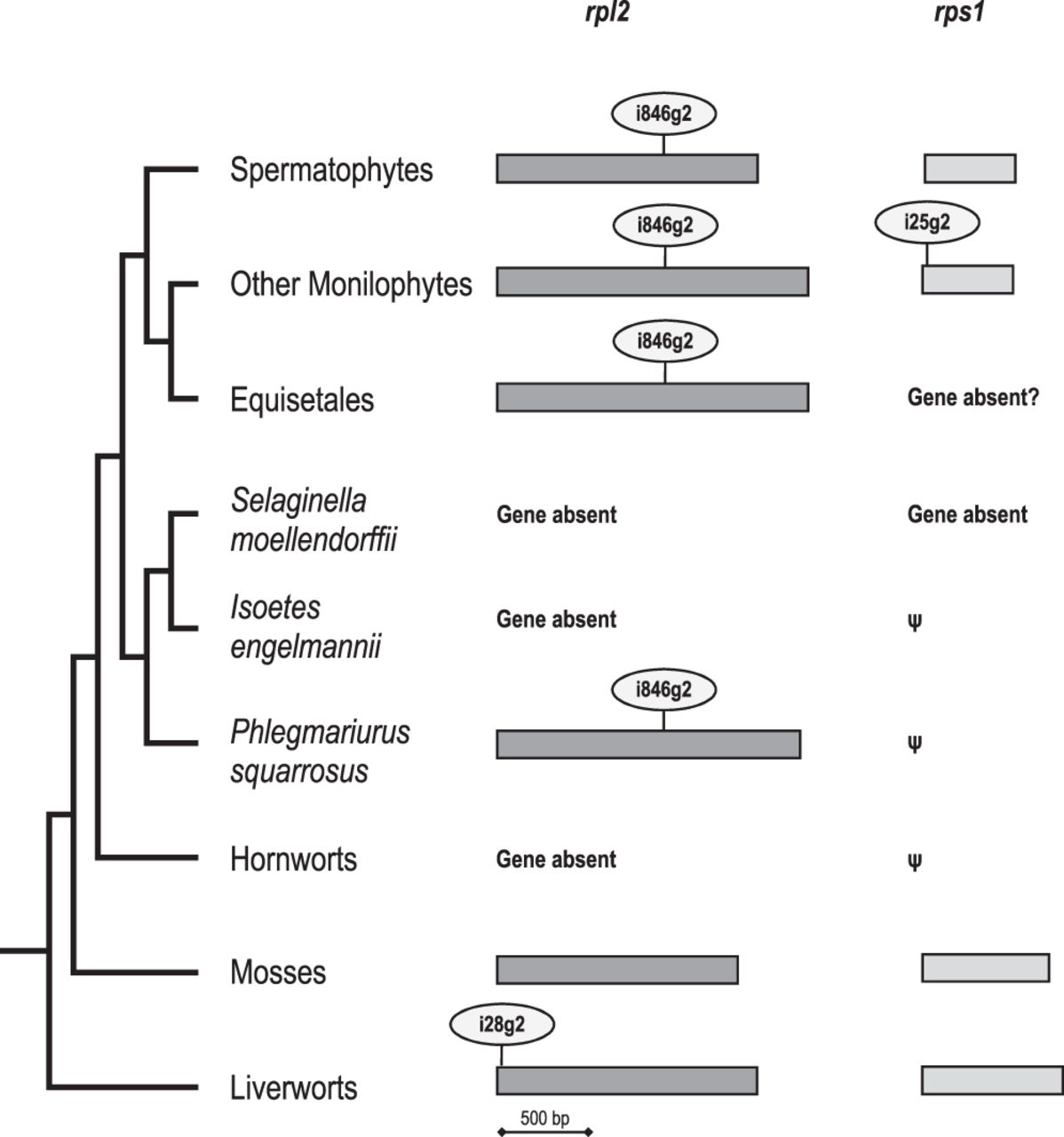
Phylogenetic overview on the mitochondrial rpl2 and rps1 genes and their respective introns in land plants. The rpl2 gene is present in the mitochondrial genomes of liverworts, mosses, the lycophyte Phlegmariurus squarrosus (Liu et al. 2012), in monilophytes (Knie et al. 2015), and in most spermatophytes (Adams et al. 2001, 2002; Adams and Palmer 2003). In hornworts (Li et al. 2009; Xue et al. 2010), lycophytes Isoetes engelmannii (Grewe et al. 2009, 2011) and Selaginella moellendorffii (Hecht et al. 2011) rpl2 genes are absent from the mtDNA, indicating transfer to the nucleus. Intron rpl2i846g2 is present in all tracheophytes where rpl2 is retained in the mtDNA with the exception of independent losses in Mimulus guttatus (Mower et al. 2012) and Equisetum bogotense (Knie et al. 2015). Liverworts carry the unrelated intron rpl2i28g2 in their mitochondrial rpl2 genes. The rps1 gene is likewise conserved in liverworts, mosses, and many spermatophytes. No homologs or only pseudogene fragments exist in hornworts and lycophytes. Monilophytes, except Equisetales, have conserved rps1 genes featuring the unique intron rps1i25g2 except for the genus Ophioglossum where the intron is secondarily lost (this study).




