


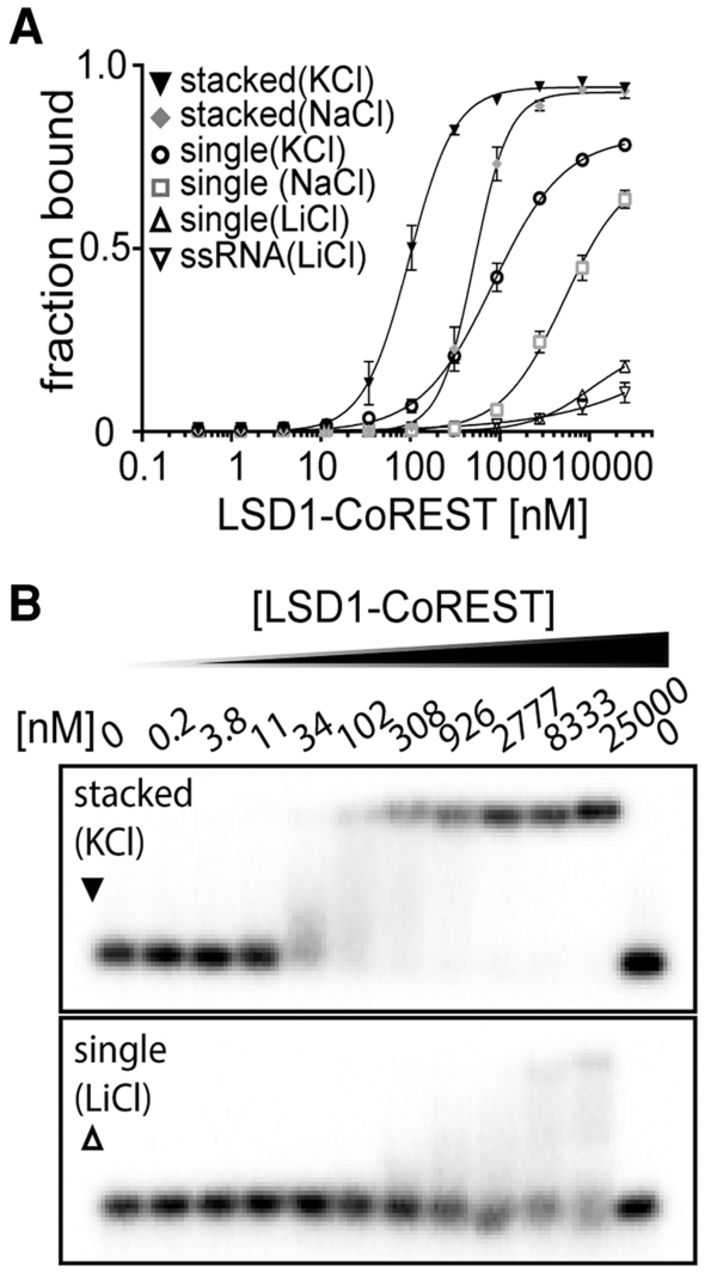
Affinity and specificity of LSD1–CoREST binding to distinct nucleic acid structures is dependent on monovalent ions. (A) Analysis of gel-mobility shift assay binding curves of (UUAGGG)8U, (UUAGGG)4U, and 25-nt ssRNA. Assays were performed in potassium (K+), sodium (Na+), and lithium (Li+) (symbols same as in Fig. 2) using LSD1–CoREST (amino acid residues 171–852 and 286–482, respectively) with exogenous protein purification tags removed. LSD1 strongly prefers to bind stacked GQ-forming RNA structures. The plot shows the fraction of RNA bound at various LSD1–CoREST concentrations (log scale). Error bars for each data point represent the range of three independent experiments. The dissociation constant (Kd) and Hill coefficient (h) from this analysis are reported in Table 1. (B) Representative gels showing that RNA binding activity of LSD1–CoREST is dependent upon the ability to form a GQ RNA conformation. Complexes and free oligonucleotides were resolved on a 0.6% native agarose gel. The concentration of the LSD1–CoREST complex is noted for each lane (nM).




