


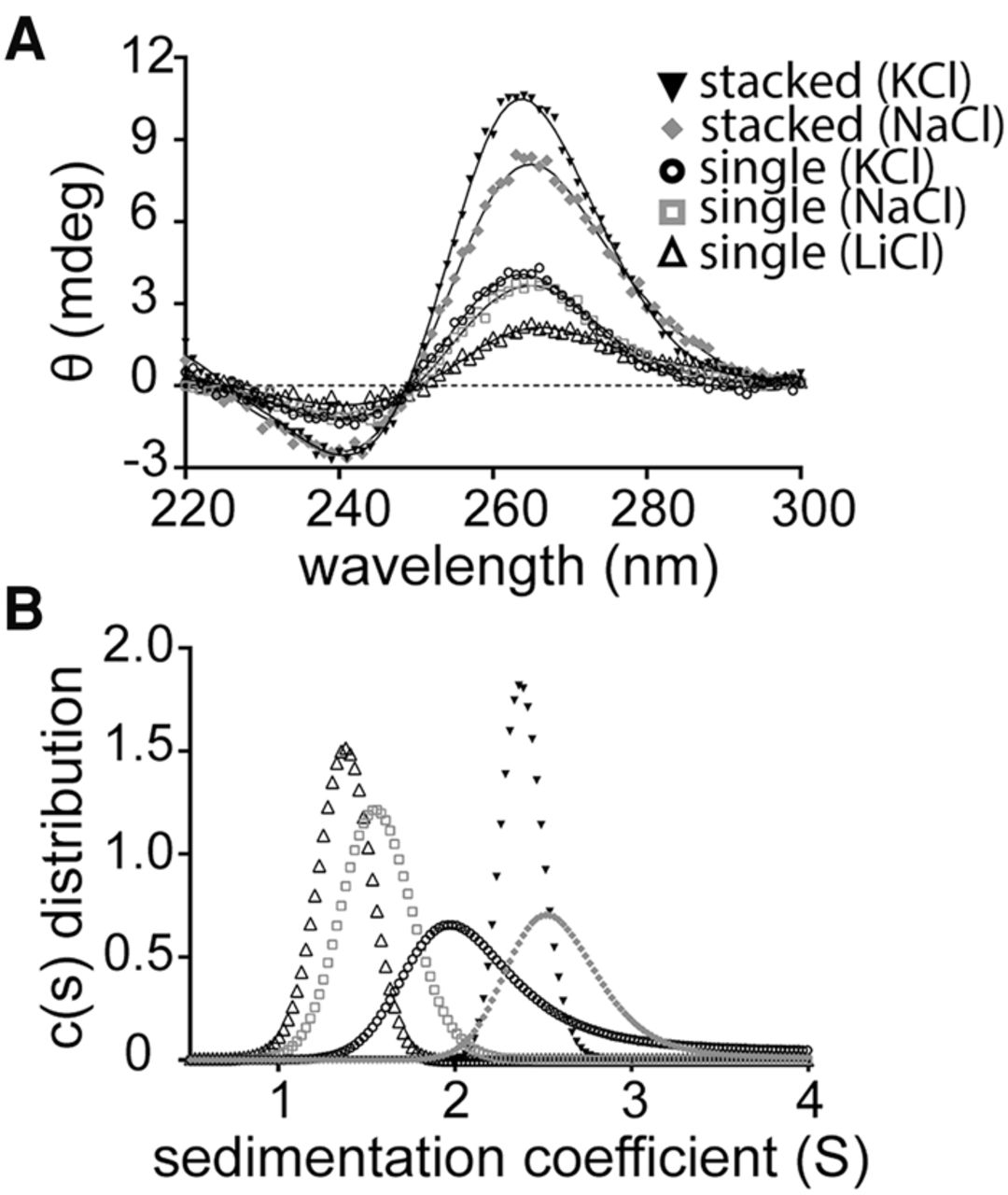
Monovalent ions dramatically influence the structure of GQ-forming RNAs. (A) Parallel-stranded GQ RNAs are known to have an Θmax of ∼263 nm (Balaratnam and Basu 2015). Circular dichroism spectroscopy demonstrates that parallel-stranded GQ structures form in the presence of potassium (black, solid triangle, and circles) and sodium (gray diamond and box), consistent with previous studies. In contrast, lithium (outlined triangles) destabilizes GQ formation. (B) The analysis of analytical ultracentrifugation (AUC) data of (UUAGGG)4U and (UUAGGG)8U RNAs in the presence of potassium (K+), sodium (Na+), and lithium (Li+). Figure symbols as in A. The plot shows an overlay of the continuous distribution [C(s)] versus the sedimentation distribution coefficient (S).




