


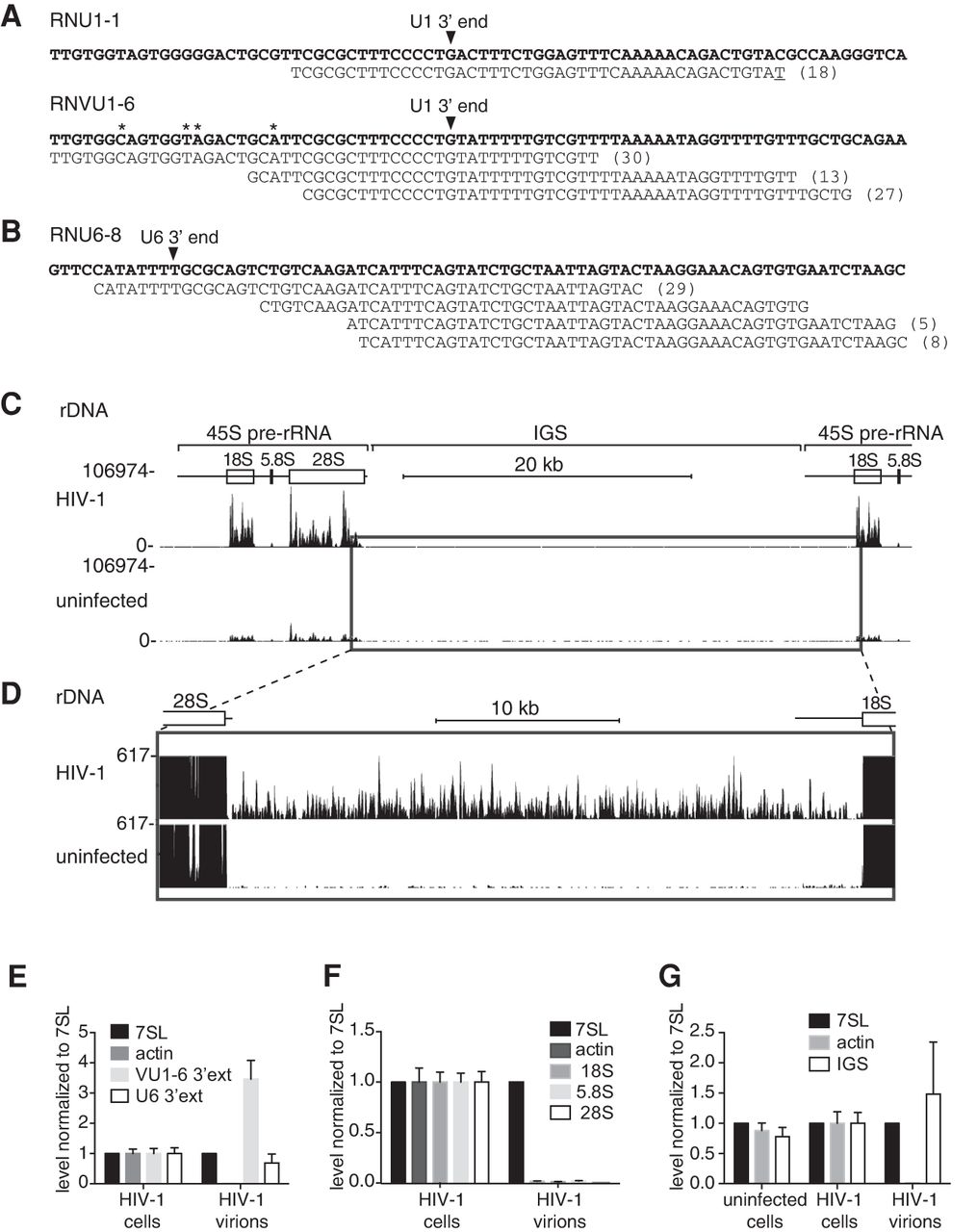
HIV-1 selectively encapsidates pre-snRNAs and rDNA IGS transcripts. (A) Reads derived from transcription of the major U1 snRNA genes (RNU1-1; top group) and a variant locus (RNVU1-6; bottom group). The RNU1-1 and RNVU1-6 gene sequences are in bold type, with the mature U1 3′ end indicated by an arrow. Parentheses, number of identical reads. Asterisks represent nucleotides that differ from the wild-type U1 snRNA. Reads mapping to the RNU1-1 locus contain a nontemplated T at the 3′ end (underline). The extra T could derive from oligouridylation of pre-U1 snRNAs by terminal U transferases or could reflect the fact that only a fraction of the tandemly repeated U1 loci are part of the current human genome assembly. (B) Reads aligning to the U6 locus at chr14: 32,672,370–32,672,475. The RNU6-8 genomic sequence is on top (bold type). The arrow indicates the mature 3′ end. (C) Reads aligned to rDNA (chrUn_gl000220:105,424–157,100). The positions of two 45S rRNA precursors are indicated. The boxed region is shown in more detail in D. (D) Reads mapping to the rDNA IGS. To visualize the IGS transcripts, the read depth from the mature rRNAs was truncated. (E–G) RT-qPCR was used to determine the enrichment of 3′-extended U1 and U6 snRNAs (E), mature rRNAs (F), and IGS transcripts in virions produced in CEM-SS cells (G). All values were normalized to 7SL RNA. Actin, a randomly encapsidated mRNA.




