


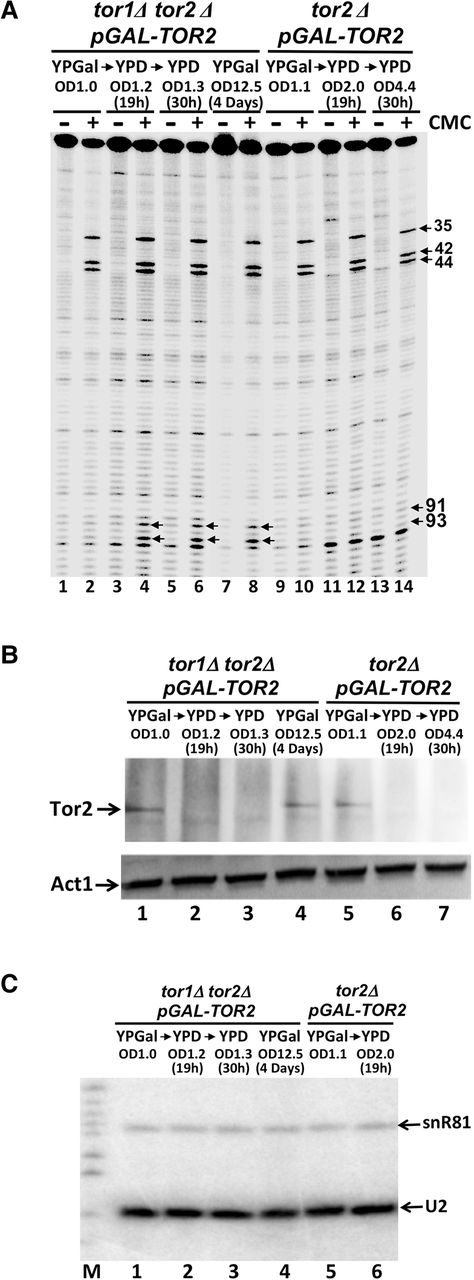
The TOR signaling pathway controls Ψ93 formation. (A) Yeast strain (tor1Δ tor2Δ pTOR2 [under the control of PGal]), where a Gal-controlled TOR2 (plasmid borne) is present and both chromosomal TOR1 and TOR2 are deleted, was grown in galactose medium to OD 1.0 (lanes 1 and 2). Cells were transferred to glucose medium and allowed to grow to OD of 1.2 (lanes 3 and 4) or 1.3 (lanes 5 and 6), or were allowed to continue to grow in galactose medium to OD 12 (lanes 7 and 8). In addition, another strain (tor2Δ pTOR2 [under the control of PGal]), where only chromosomal TOR2 is replaced by a plasmid borne and Gal-controlled TOR2, was grown in exactly the same way as above. Lanes 9 and 10, cells grown in galactose medium to OD 1.1; lanes 11 and 12, cells grown in glucose medium to OD 2.0 after switch from galactose medium to glucose medium; lanes 13 and 14, cells grown in glucose medium to OD 4.4 after switch from galactose medium to glucose medium. Upon completion of cell culture, total RNA was recovered and pseudouridylation assay conducted. Signals representing constitutively formed pseudouridines (Ψ35, Ψ42, and Ψ44) and inducibly formed Ψ93 and Ψ91 are indicated. (B) Upon completion of cell culture, total protein was also isolated and Western blot against Tor2 and Act1 (control) performed. (C) Total RNA described in A was also used for Northern analysis to monitor the level of snR81 box H/ACA RNA relative to the level of U2 snRNA (control).




