


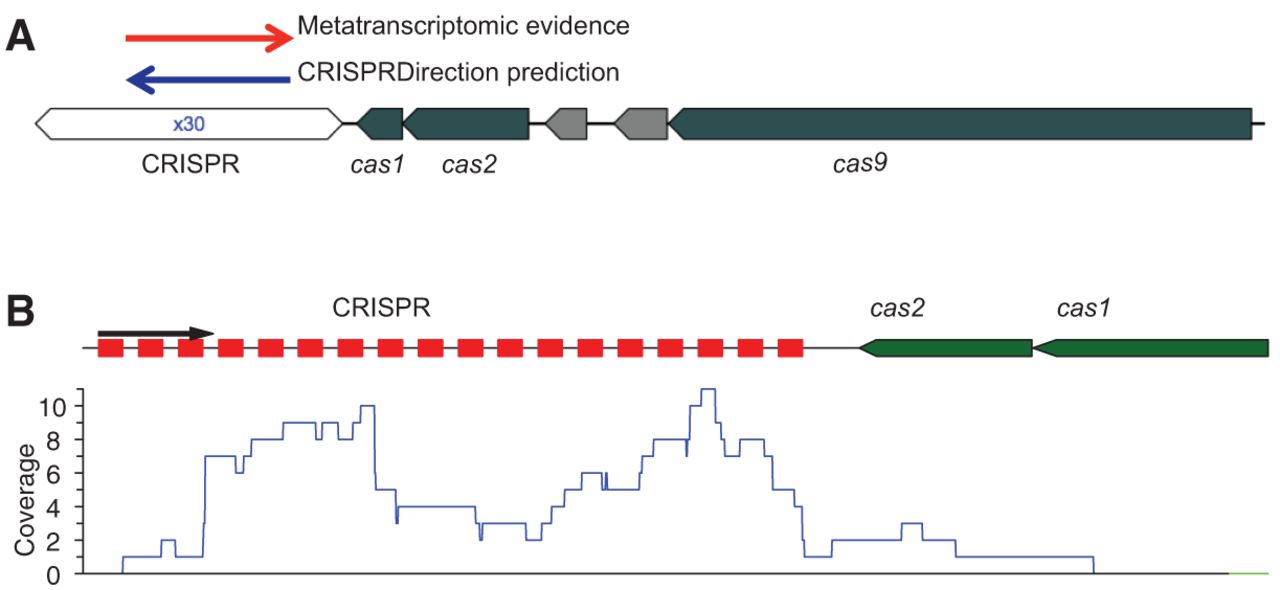
Predicted transcription orientation for a CRISPR–Cas system associated with B. fragilis 638R, a type II-C CRISPR–Cas system, using metatranscriptomic data. As demonstrated in the reference genome (A), the transcription direction supported by metatranscriptomic sequencing data is opposite to the predicted orientation by CRISPRDirection. Repeat sequence in its predicted orientation is shown in Table 1. In this plot green arrows represent putative cas genes, and CRISPR arrays are shown in white hexagons with numbers inside the hexagons (followed by letter x) indicating the number of repeat-spacer units. (B) An example transcriptional profile for a contig (of 2278 bp; assembled from sample X317802115; id: 1280918) containing this CRISPR–Cas system. All metatranscriptomic reads mapped to the CRISPR in this contig (repeats are shown as red squares) are in one direction, which faces the cas genes, just as in the reference genome. We note no metatranscriptomic reads were mapped to the reverse strand of the contig (i.e., the sense strand of the cas genes).




