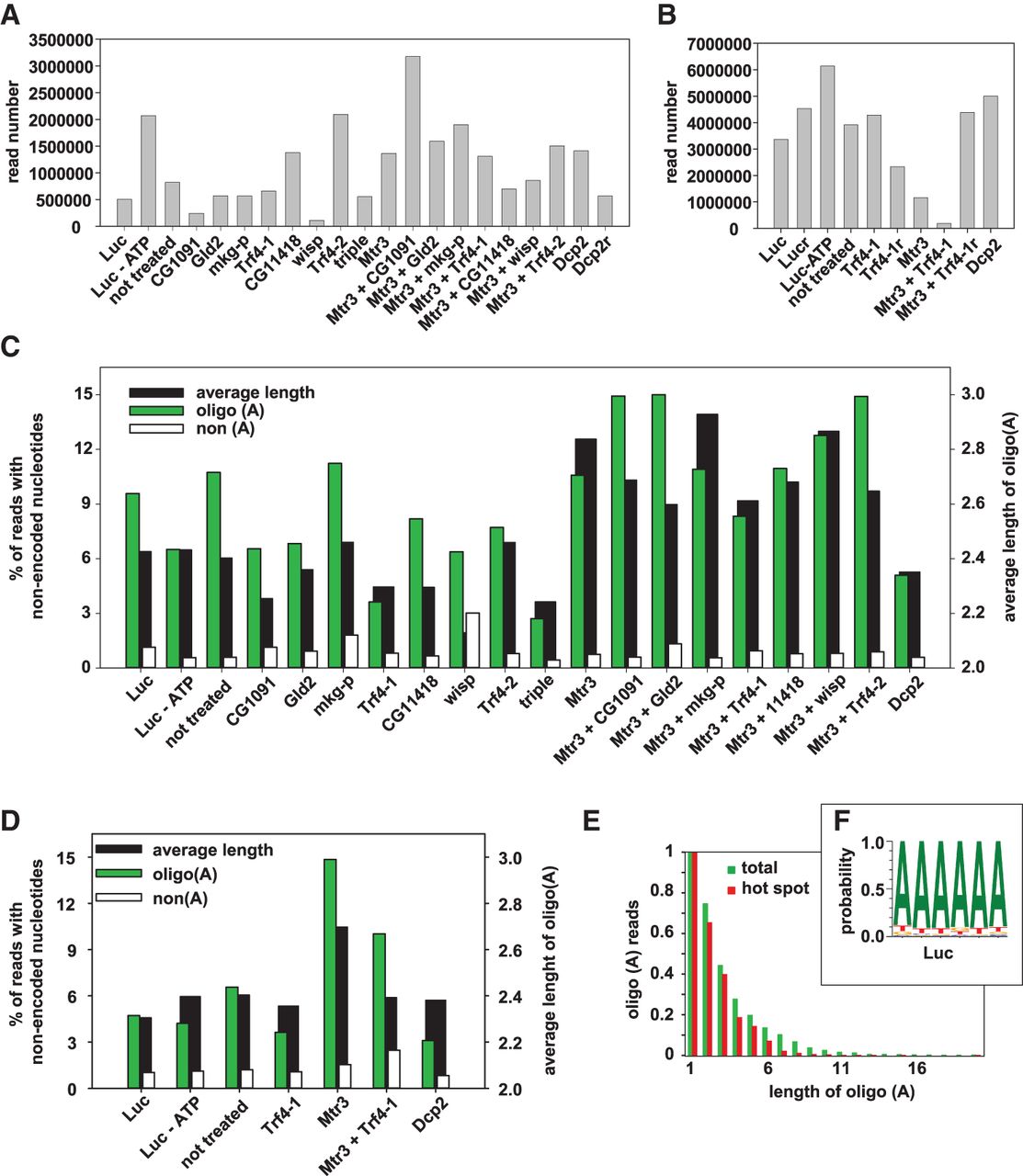
Illumina sequencing analysis of nonencoded 3′ nucleotides. Data were obtained by the procedure outlined in Figure 1. Labels at the bottom of each figure refer to the dsRNA treatment. Luc, luciferase RNA control; not treated, no dsRNA added; luc-ATP, cells treated with luciferase control RNA and adaptor ligation carried out in the absence of ATP (see Materials and Methods); triple, combined knockdown of CG1091, mkg-p, and Trf4-1. (A) Read numbers of individual sequencing libraries in the first and (B) in the second experiment. In B, samples “Luc r” and “Mtr3 + Trf4-1 r” are technical replicates of the respective preceding sample. (C) Summary of nonencoded 3′ nucleotides in the first and (D) in the second experiment. In D, two samples are averages of two technical replicates as explained for B. (E) Length distributions of oligo(A) tails summarized over the three control libraries of Figure 2C at all internal positions [i.e., excluding the regular poly(A) tail] and at the 392/393 hot spot. The number of tails consisting of a single A was set to 1. This plot represents the length distribution up to 20 nt. Note that in all other analyses, only extensions up to 6 nt were included as explained in Materials and Methods. (F) Sequence composition of the nonencoded 3′ extensions in the luciferase control knockdown experiment represented as sequence logo. For this analysis, tails of between one and six nonencoded nucleotides were used independently of their sequence. Only tails from internal positions were used, i.e., the regular poly(A) tail was excluded from the analysis.