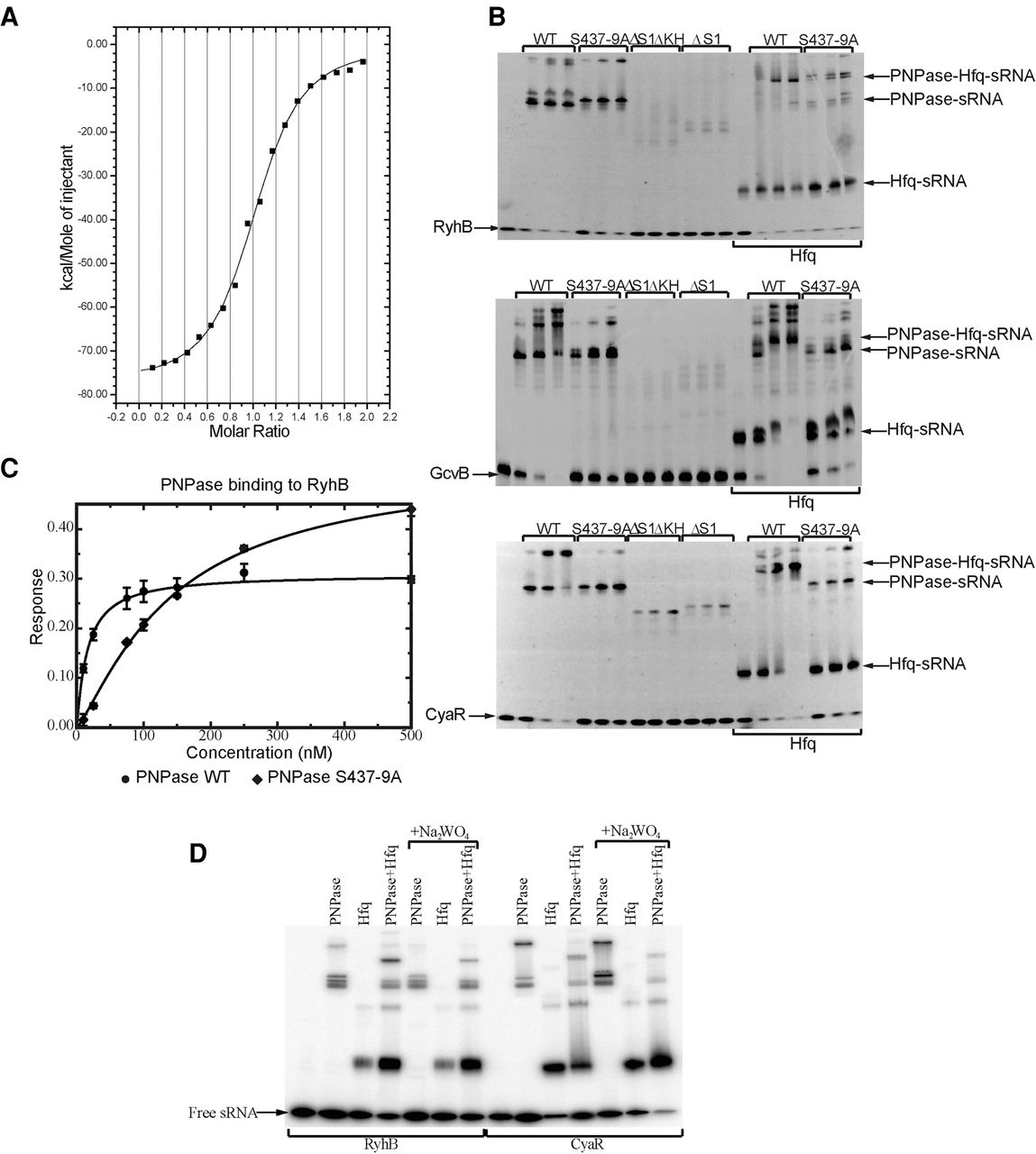
PNPase binds sRNAs directly and as a ternary complex with Hfq. (A) RyhB interactions with PNPase evaluated by isothermal titration calorimetry. All binding experiments were performed in the absence of phosphate to prevent phosphorylysis. The fitted binding parameters for the isotherm are N = 1.01 ± 8.5 × 10⁻³, K = 1.17 × 10⁻⁷± 9.4 × 10⁻⁵ M−1, ΔH = −7.17 × 10⁻⁴ ± 890.1 cal/mol, ΔS = −224 cal/mol/deg. (B) The PNPase/sRNA interactions require the S1 and KH domains and active sites. Electrophoretic mobility shift binding assays of PNPase (0.2, 0.4, and 0.6 μM) with RyhB, CyaR, and GcvB (0.2 μM) are shown. Binding experiments include deletion mutants of the KH and S1 RNA-binding domains of PNPase and the presence of Hfq (0.2 μM). (C) Binding of PNPase and active site mutant by surface binding analysis. The RNA with a 5′-biotinyl modification was immobilized on the streptavidin-coated detector tip of an Octet device and isotherms measured in solutions of varying protein concentration. (D) Gel shift mobility assays in the presence of 2 mM sodium phosphate and 10 mM sodium tungstate of RyhB and CyaR with PNPase (30 nM), Hfq (15 nM), and those two proteins combined.