


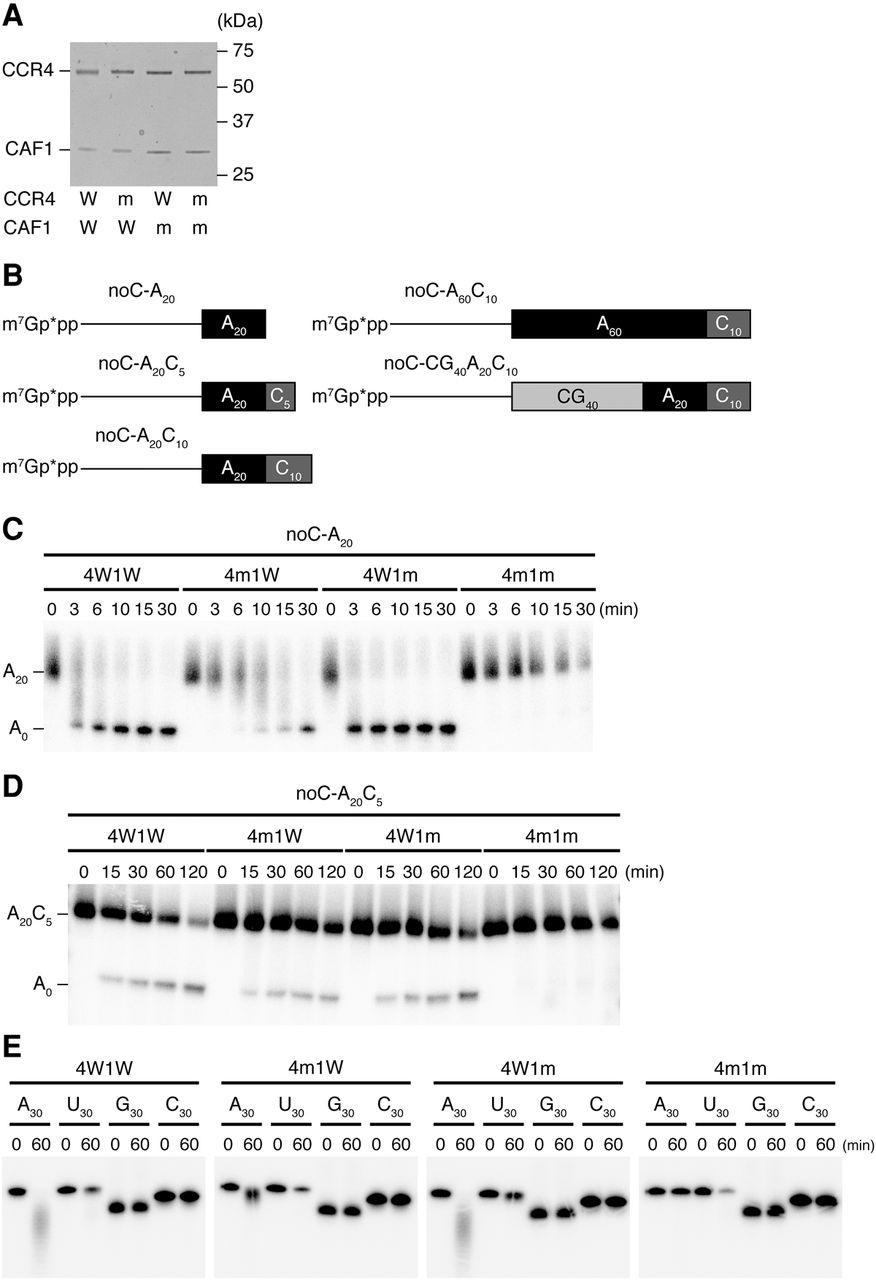
CCR4 and CAF1 have an intrinsic activity to remove post-poly(A) sequences. (A) SDS-PAGE and Coomassie brilliant blue staining for four types of recombinant Drosophila CCR4/CAF1 heterodimer, in which both CCR4 and CAF1 are wild types, either one of them is catalytic mutant, and both of them are catalytic mutants. (W) Wild type, (m) catalytic mutant. (B) Schematic representation of a series of noC reporter constructs. These reporter RNAs were capped with [α-32P] GTP. The subscripts show the length of an RNA sequence including the shown base. The asterisks indicate a radiolabel. (C) Deadenylation assay for noC-A20 with four types of recombinant CCR4/CAF1 heterodimer. The heterodimers showed deadenylation activity for the A20 reporter except for 4m1m. (4W1W) CCR4 and CAF1 are wild types, (4m1W) CCR4 is catalytic mutant and CAF1 is wild type, (4W1m) CCR4 is wild type, CAF1 is catalytic mutant, (4m1m) CCR4 and CAF1 are catalytic mutants. (D) Deadenylation assay for noC-A20C5 with four types of recombinant CCR4/CAF1 heterodimer. Despite the fact that the reporter RNA had C5 following A20, CCR4 and CAF1 could deadenylate. (E) 30 nt poly(A), (U), (G), and (C) RNAs were incubated with four types of recombinant CCR4/CAF1 heterodimer. Both CCR4 and CAF1 strongly preferred poly(A) as a substrate. Note that poly(U) was slightly degraded in all cases (even for the 4m1m double-mutant heterodimer), presumably due to contaminating nonspecific nuclease(s).




