


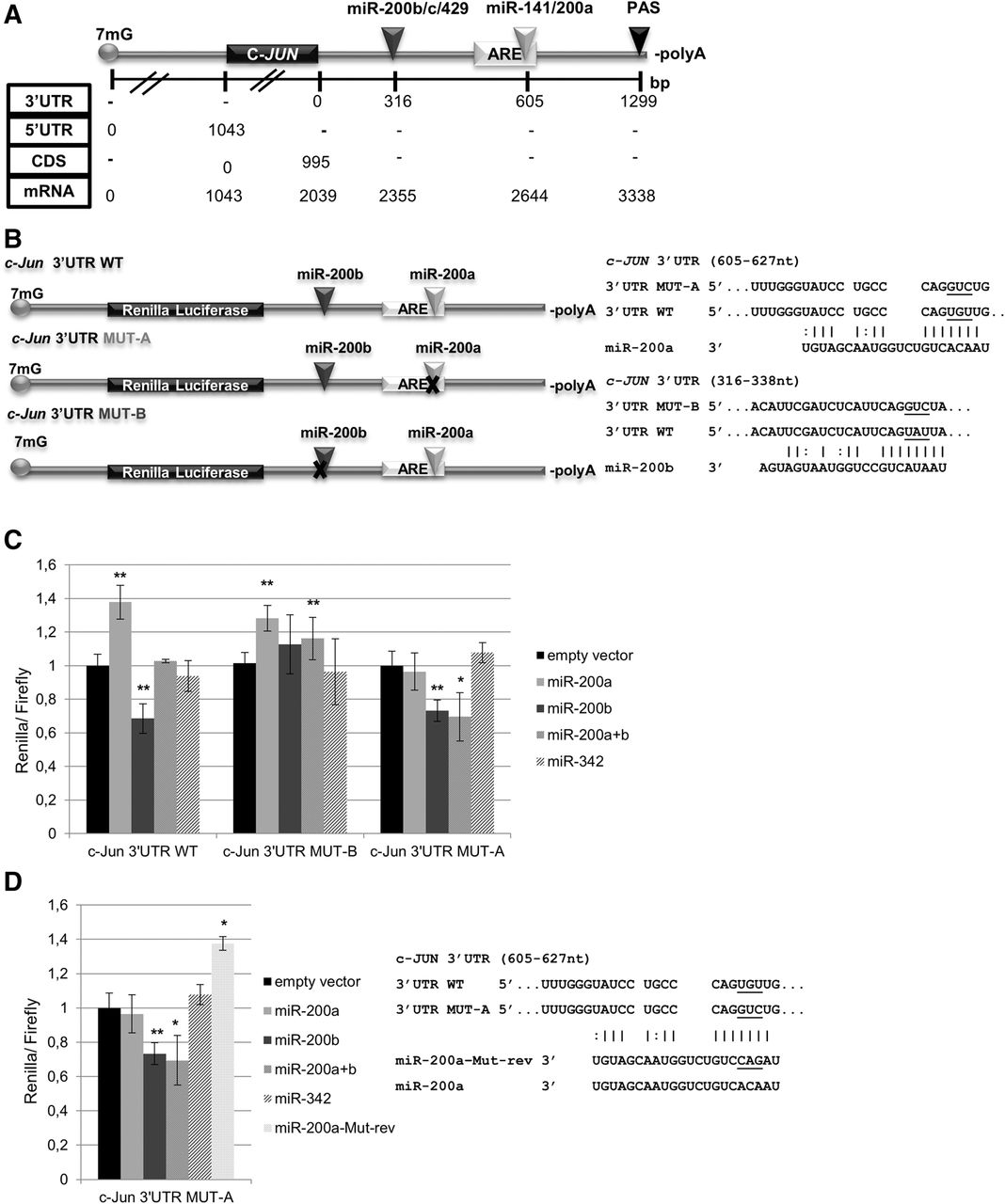
(A) Schematic of the c-Jun 3′UTR with the location of the predicted miR-200a/14 and miR-200b/c/429 target sites. (B) Schematic of the Luciferase constructs with c-Jun 3′UTR WT, mutants A or B (left panel) and alignment of c-Jun 3′UTR WT or mutated (MUT-B or MUT-A) with seed region of miR-200b or miR-200a (right panel); the mutated nucleotides are underlined. (C) Luciferase assay with HEK 293T cotransfected with reporter construct (c-Jun 3′UTR WT, c-Jun 3′UTR MUT-A, c-Jun 3′UTR MUT-B) and a microRNA overexpressing plasmid (miR-200a, miR-200b, miR-342) revealed an antithetical effect of miR-200a and miR-200b on c-Jun 3′UTR. The mean values of the corresponding empty vector were set to one. (D) Luciferase assay on HEK 293T, cotransfected with reporter construct c-Jun 3′UTR MUT-A and microRNA overexpressing plasmids (miR-200a, miR-200b, miR-342, miR-200a-comp-mut), indicated that, in the presence of the compensatory mutation in the seed sequence of miR-200a, the inductive effect of the miRNA on the c-Jun 3′UTR is recovered. The mean value of the corresponding empty vector was set to one. Data represent the mean ± SD and asterisks (*) indicate statistically significant modulations with respect to empty vector according to paired Student's test. (*) P < 0.05; (**) P < 0.01.




