


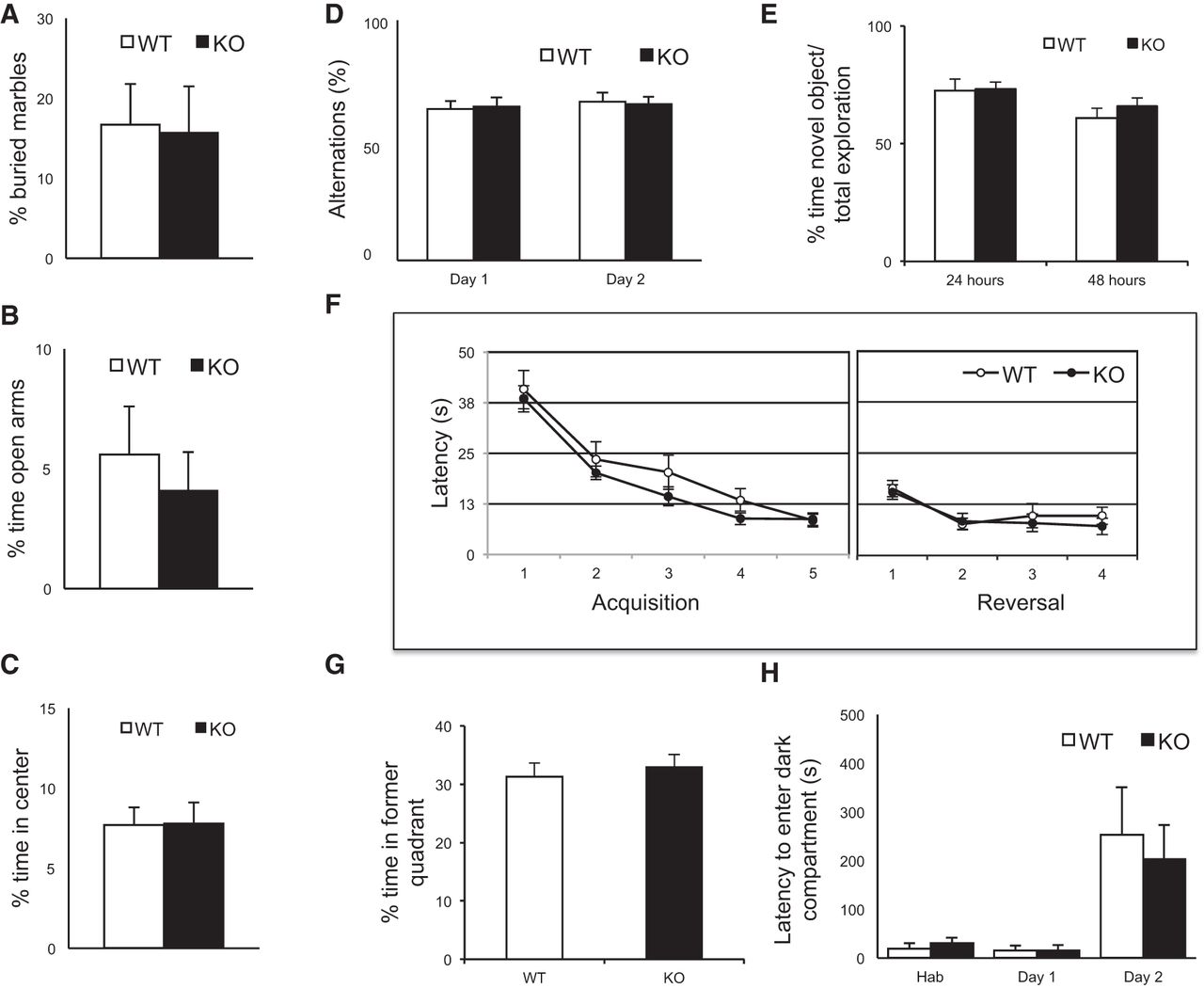
WT and Gld2 KO mice exhibit similar behaviors. (A) Marble burying test to measure obsessive-compulsive behavior and aversion to new objects (WT = 12 mice; Gld2 KO = 14 mice; P > 0.05, unpaired t-test). All error bars in the figure refer to SEM. (B) Elevated plus maze used to assess anxiety objects (WT = 11 mice; Gld2 KO = 11 mice; P < 0.05, unpaired t-test). (C) Open field test to measure anxiety (WT = 12 mice; Gld2 KO = 12 mice; P < 0.05, unpaired t-test). (D) T-maze assay of spontaneous alternation used to assess working memory (WT = 11 mice; Gld2 KO = 12 mice; P < 0.05, unpaired t-test). (E) Novel object recognition as a memory and object recognition test (WT = 12 mice; Gld2 KO = 14 mice; P < 0.05, unpaired t-test). (F) Morris water maze to investigate spatial learning and memory; left panel depicts acquisition (WT = 12 mice; Gld2 KO = 13 mice; P < 0.05, unpaired t-test) and right panel depicts reversal (WT = 12 mice; Gld2 KO = 13 mice; P < 0.05, unpaired t-test). (G) Morris water maze probe trial after acquisition phase (WT = 12 mice; Gld2 KO = 13 mice; P < 0.05, unpaired t-test). (H) Passive avoidance test used to assess learning and memory (WT = 3 mice; Gld2 KO = 3 mice; P < 0.05, unpaired t-test). (Hab) Habituation.




