


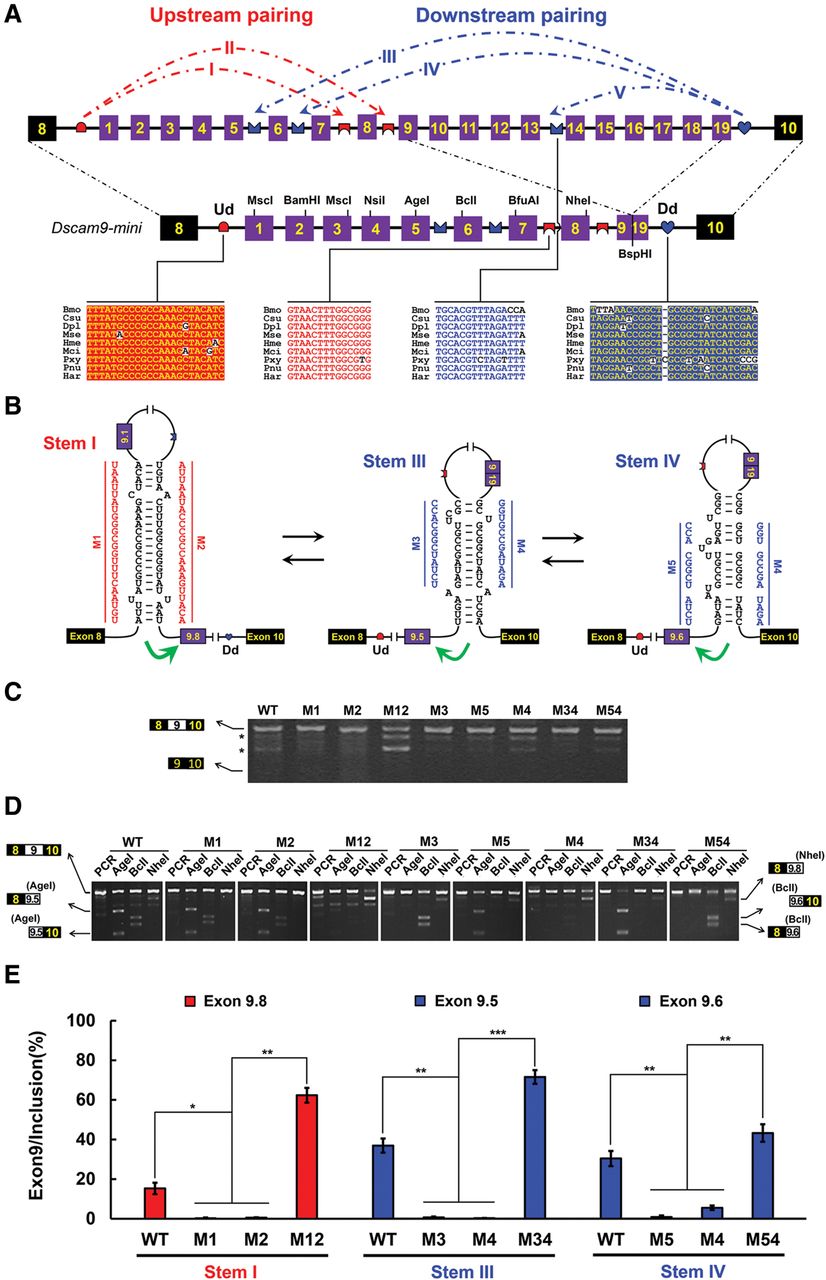
The evolutionarily conserved bidirectional pairings within Dscam exon 9. (A) Overview of the silkworm minigene constructs. Symbols used are the same as those in Figure 1. The nucleotides with greatest identity to the docking sites and selector sequences are shown in different colors. (B) Schematic diagrams of the minigene constructs for the predicted RNA pairings. Mutations introduced into dsRNA are indicated on the left or right mutated sequences (M1–M5). (WT) Wild type. (C) Effects of bidirectional intronic RNA pairings on exon 9 inclusions for disruptive single mutations (M1–M5) and compensatory double mutations (M12; M34; M54). The band marked by “*” is a nonspecific RT-PCR product. (D) Effects of bidirectional RNA pairings on exon 9 selections. The PCR lanes represent the single exon 9-containing band cut from C. Variant-specific restriction digestion was performed to analyze the frequency of exon 9 utilization. (E) Quantization of the data in D. Data are expressed as percentages of the mean ± SD from three independent experiments. (*) P < 0.05, (**) P < 0.01, (***) P < 0.001 (Student's t-test, two-tailed).




