


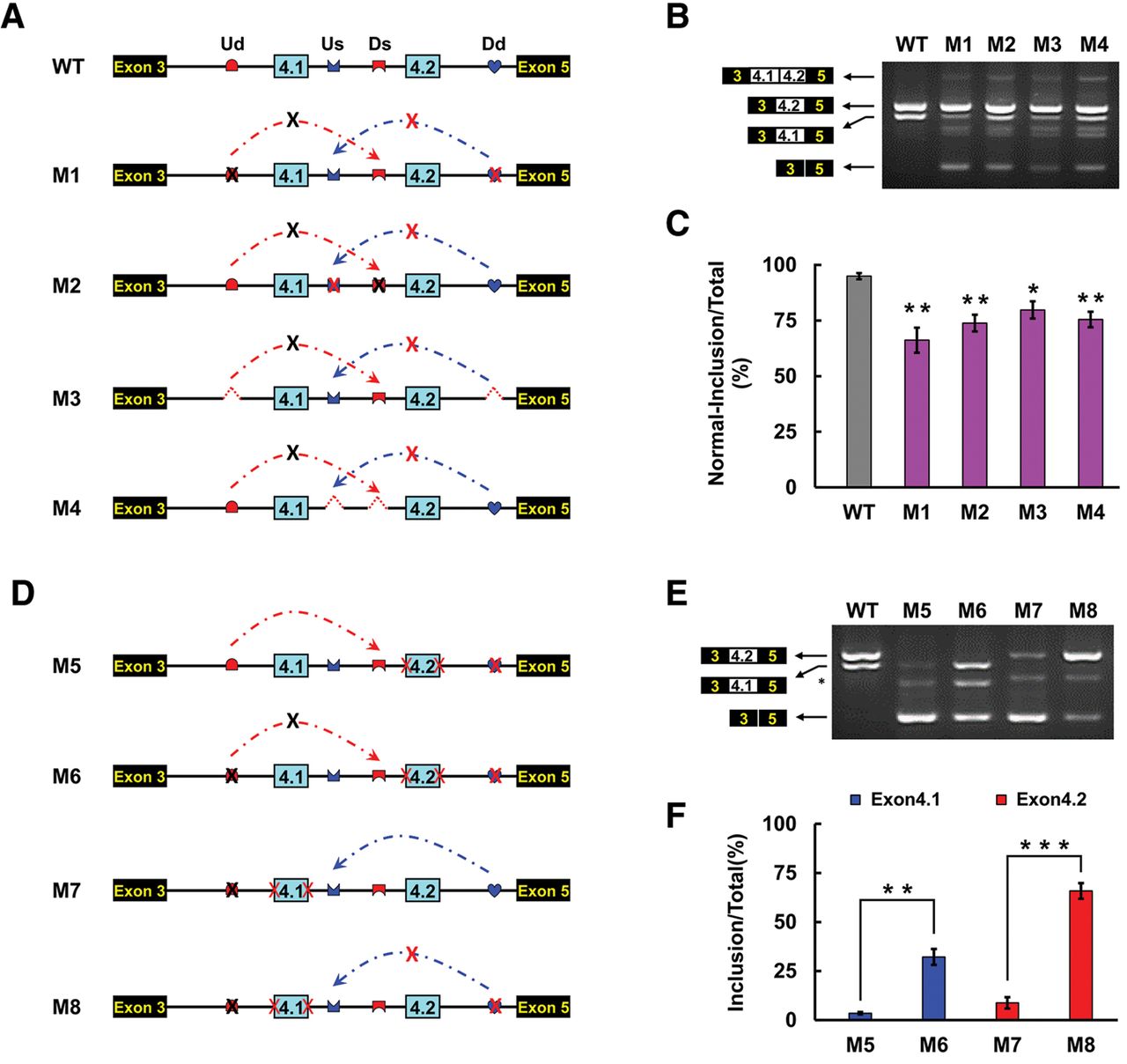
Dual RNA pairings facilitate mutually exclusive splicing fidelity. (A) Schematic diagrams of mutant minigene constructs. The symbols used are the same as those in Figure 1. A cross denotes a disrupting mutation, while the dashed arrow plus a cross represents abolishment of the RNA–RNA interaction. (B) The effect of the simultaneous disruption of upstream and downstream pairing on exon 4 inclusion. (C) The simultaneous disruption of upstream and downstream pairing led to increased aberrant splicing of exon 4. (D) Schematic diagrams of the mutants used to evaluate the effect of suppression on inclusion of the in-loop exon by RNA secondary structure. (E) The effect of upstream (or downstream) RNA pairing disruption on exon 4.1 (or exon 4.2) inclusion in the absence of stem II (or stem I). The band marked by “*” is a nonspecific RT-PCR product. (F) The disruption of upstream (or downstream) RNA pairing caused increased exon 4.1 (or exon 4.2) inclusion. Data are expressed as percentages of the mean ± SD from three independent experiments. (*) P < 0.05, (**) P < 0.01, and (***) P < 0.001 (Student's t-test, two-tailed).




