


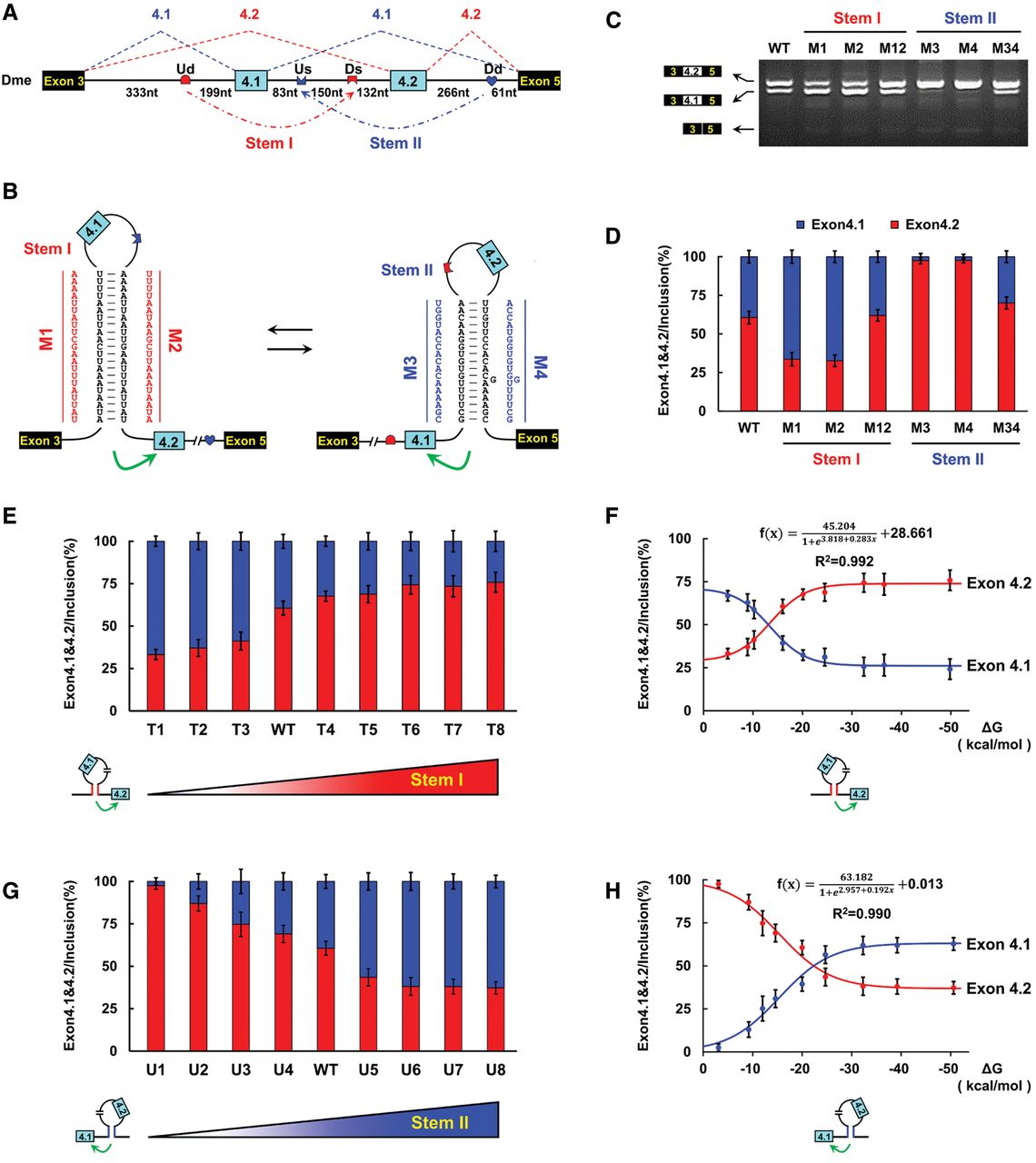
Bidirectional RNA pairing controls alternative exon 4 inclusion in Drosophila srp pre-mRNAs. (A) A schematic diagram of the partial pre-mRNA, with constitutive exons depicted as black boxes, mutually exclusive exons as cyan boxes, and introns as lines. The dashed arrow represents the formation of the RNA–RNA interaction. Upstream and downstream docking sites (Ud and Dd; marked by semicircles and hearts, respectively) were complementary to a downstream or upstream selector sequence (Ds and Us; marked by saddle shapes). (B) Predicted RNA pairing of D. melanogaster srp pre-mRNA. A green arrow depicts activation of the inclusion of the proximal exon. Mutations introduced into dsRNA stem are indicated in the left or right mutated sequences (M1–M4). The RNA pairings for other Drosophila species are shown in Supplemental Figure S3. (C) Effects of mutations on exon 4 inclusion are indicated for disruptive single mutations (M1–M4) and compensatory double mutations (M12 and M34). (WT) Wild type. (D) Effects of mutations on exon 4.1 and exon 4.2 selection. (E) The effect of changing the upstream RNA pairing (stem I) strength on exon 4 selection. Predicted RNA pairings for the mutants (T1–T8) are shown in Supplemental Figure S4A. (F) Exon 4.2 inclusion correlated with the upstream RNA pairing (stem I) strength. (G) The effect of changing the downstream RNA pairing (stem II) strength on exon 4 selection. Predicted RNA pairings for the mutants (U1–U8) are shown in Supplemental Figure S4B. (H) Exon 4.1 inclusion correlated with the downstream RNA pairing (stem II) strength. Data are expressed as percentages of the mean ± SD from three independent experiments.




