


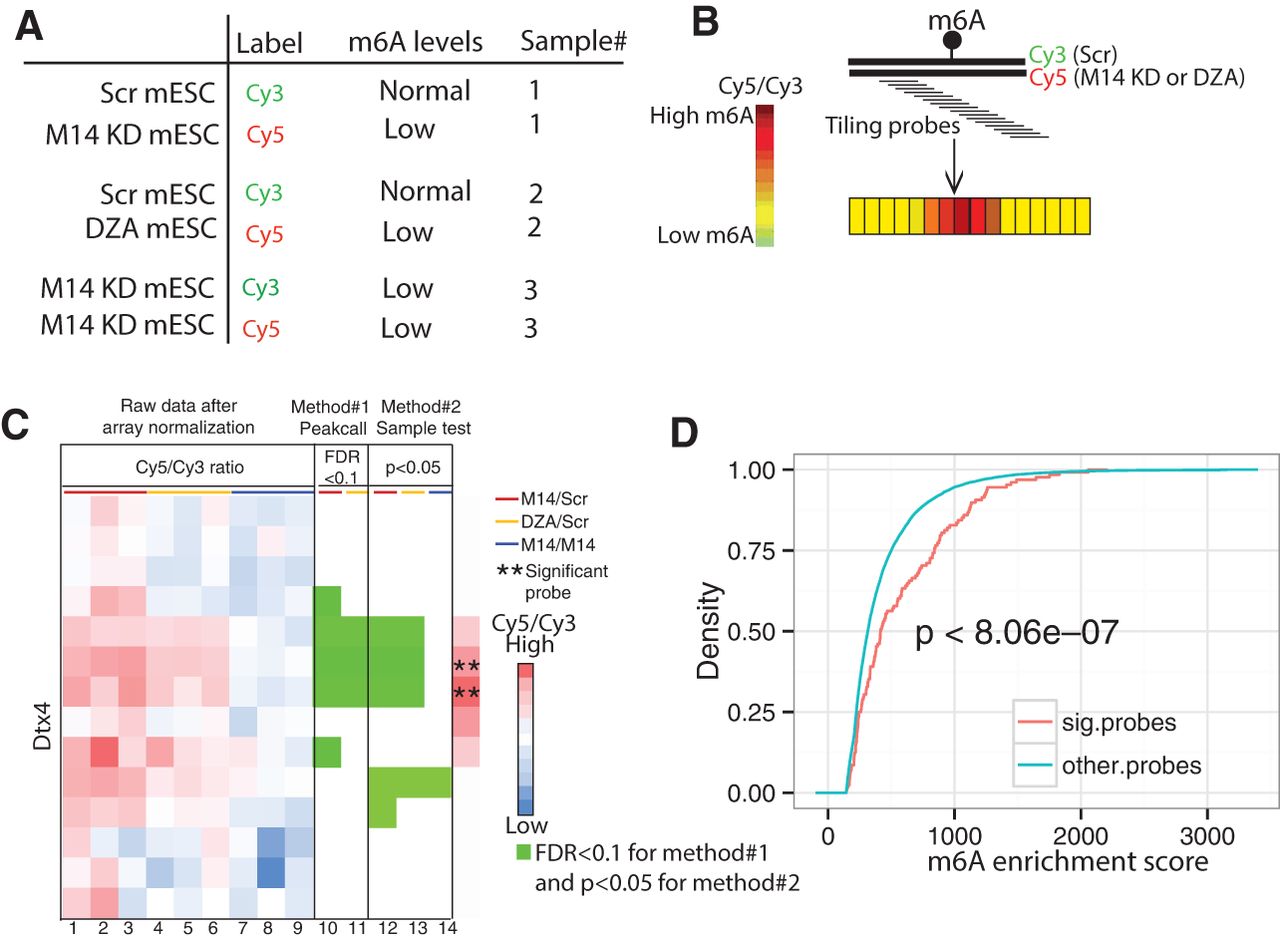
Detection of highly enriched m6A sites in mESCs. (A) Samples used for microarray analysis. For each, three independent arrays were used in triplicate. (B) Schematic showing expected outcome. Tiling probes were used to cover a given RNA region. If m6A is present on Cy3-labeled RNA extracted from the Scramble (Scr) control but not from METTL14 KD or DZA treated samples (Cy5), we predicted increased hybridization in treated versus Scr samples, hence a high Cy5/Cy3 ratio (increased red color) of tiling probes hybridized to the m6A-containing region versus nearby probes. (C) The Dtx4 transcript, one of 66 m6A-RNA targets we identified, illustrates how we identified significant probes (SPs). Columns 1–9 display log ratios of Cy5/Cy3 for Sample 1 (METTL14 KD versus Scr; red bar; columns 1–3), sample 2 (DZA treatment versus Scr; yellow bar; columns 4–6), and sample 3 (METTL14 KD versus METTL14 KD; blue bar; columns 7–9). Each row represents a probe. Adjacent probes overlap by 19 nt. Red and blue colors indicate high and low Cy5/Cy3 ratios, respectively. Columns 10 and 11 demonstrate the peak call method. A green square represents a probe whose Cy5/Cy3 ratio from Sample 1 and/or 2 relative to 3 is significantly greater (FDR < 0.1) than the average Cy5/Cy3 ratios from surrounding probes. Panels 12–14 demonstrate the sample test method. A green square represents a probe whose average Cy5/Cy3 ratio from the biological triplicates is significantly greater (P < 0.05) than average Cy5/Cy3 ratios of all probes within the same meRIP-seq peak in Samples 1 and 2 but not 3. A significant probe (SP, marked by asterisks [**]) is defined as a probe displaying statistical significance in both methods and whose upstream probe shows statistical significance in the sample test method. (D). Cumulative density curve demonstrating that meRIP-seq peaks containing the 206 SPs exhibit significantly higher enrichment scores than those from remaining probes (P < 8.06 × 10⁻⁷, one-sided Wilcoxon rank-sum test) using previously generated MeRIP-seq data.




