


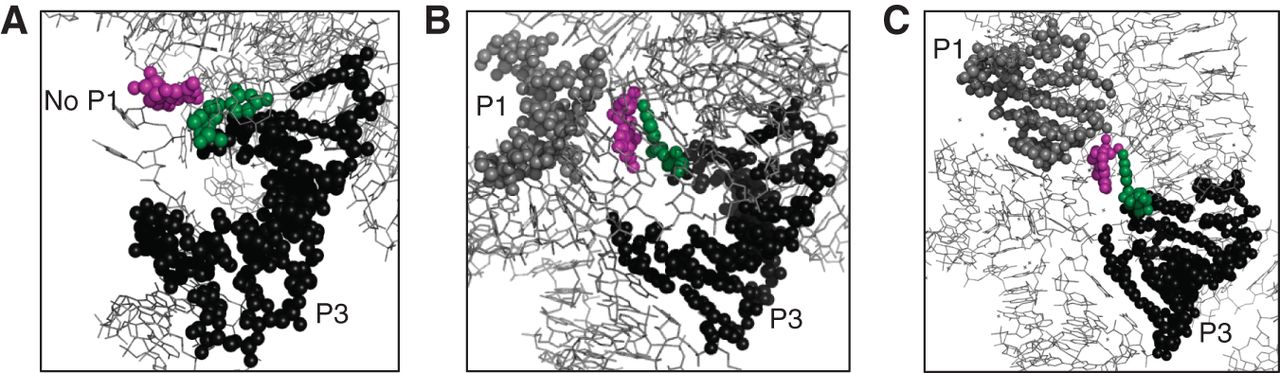
Crystallographic structures of group I introns that suggest a model for the function of mutation U271C. Shown are small portions of the structure that include the core helix P3 onto which U271 stacks. (A) The structure of a group I intron from Tetrahymena (1X8W) was made in the absence of the P1 helix. The nucleobase U271 (green spheres) is stacked onto helix P3 (black spheres) and points away from nucleotide G303 (purple spheres). The latter resides in the junction J7/8, which is known to assist the positioning of helix P1 into the catalytic site. (B) The structure of a group I intron from Twort (1Y0Q) was made in the presence of helix P1 (gray spheres). Here, the nucleotide analogous to U271 is stacked onto the nucleotide analogous to G303. (C) Similarly, the structure of a group I intron from Azoarcus (1ZZN) shows the stacking of the nucleobases analogous to U271 onto the base analogous to G303, in the presence of the P1 helix.




