


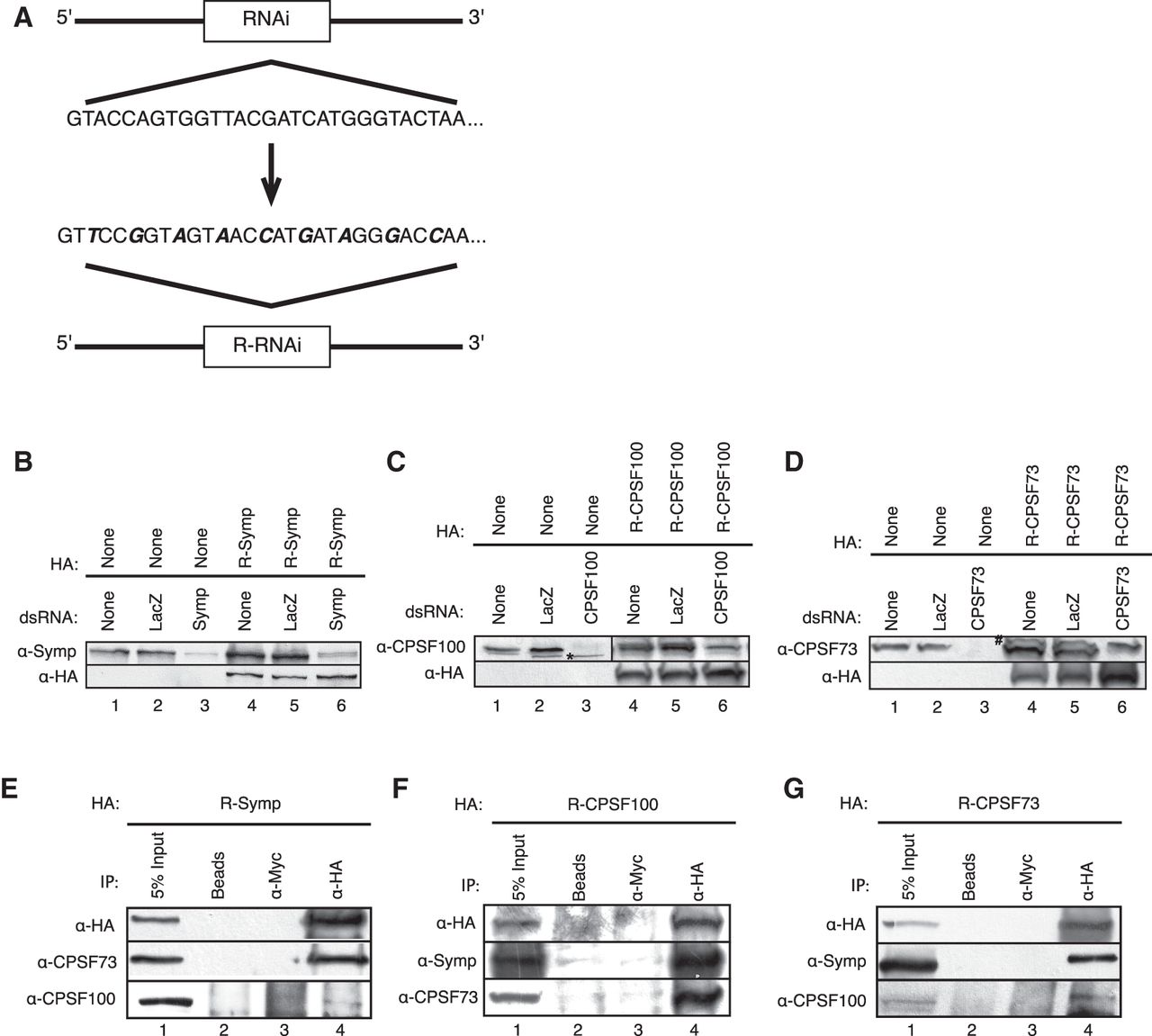
RNAi-resistant (RNAi-R) CCC factors are expressed during simultaneous RNAi-depletion of corresponding endogenous proteins and form complexes with endogenous-binding partners. (A) RNAi-R CCC components were constructed by changing the third (wobble) base of every codon within the region targeted by exogenously introduced dsRNA. (B–D) HA-tagged R-Symplekin (B), R-CPSF100 (C), and R-CPSF73 (D) were expressed in Dmel-2 cells simultaneously RNAi-depleted of the corresponding endogenous protein. The proteins were IPed, separated, and probed as described in Figure 1. Lane 3 of each top panel shows RNAi-depletion of endogenous CCC components. Simultaneous RNAi-depletion of endogenous CCC factors and exogenous expression of the corresponding protein is shown in lane 6. The “*” denotes a slightly faster migrating cross-reacting band. The “#” identifies HA-CPSF73. (E–G) RNAi-R full-length CCCs were IPed as described in Figure 1. R-Symplekin (E), R-CPSF100 (F), and R-CPSF73 (G) IP were detected with anti-HA antibody (lane 4, top panels). co-IP was assessed with anti-CCC factor antibodies. Beads only (lane 2) and α-Myc (lane 3) are nonspecific controls.




