


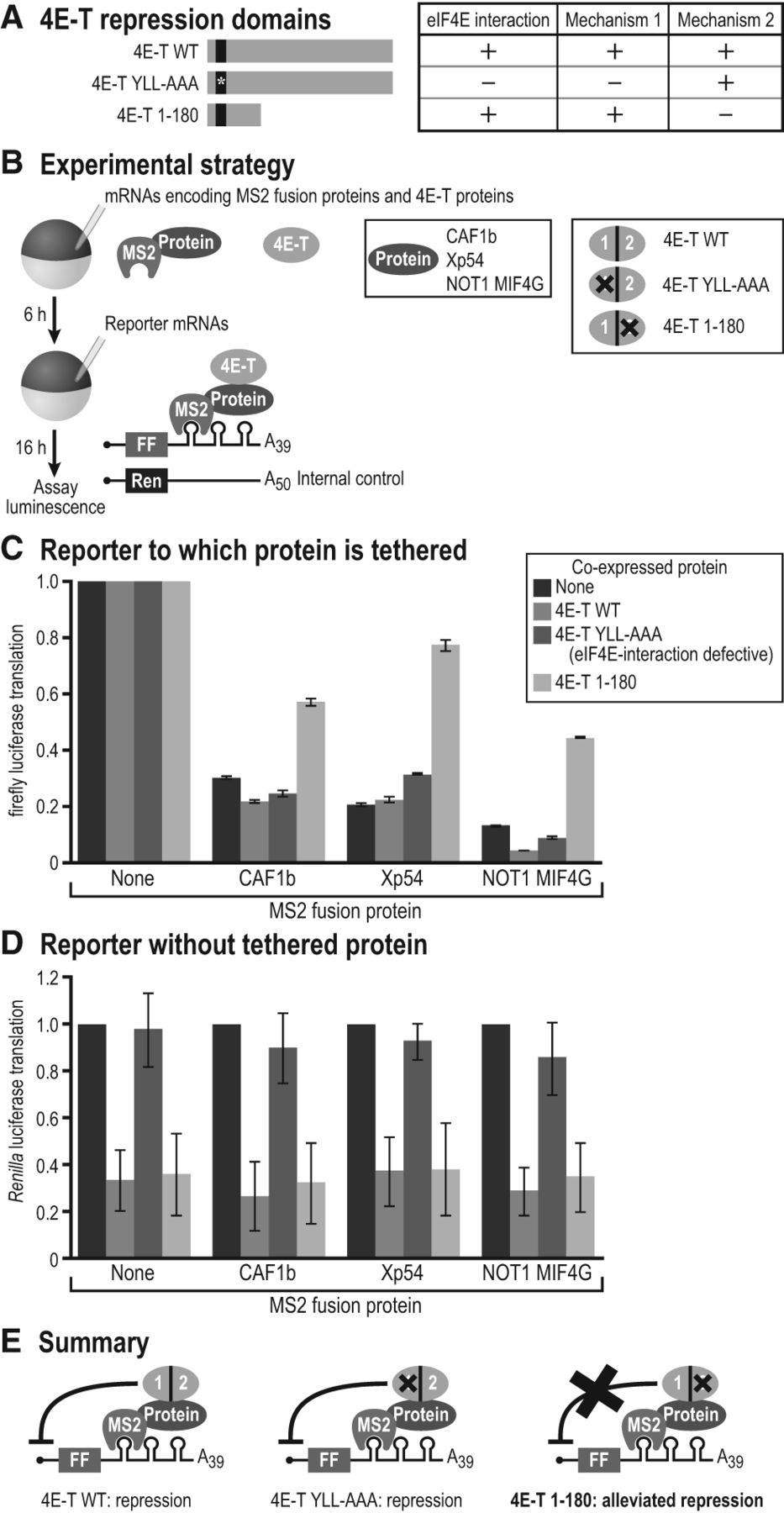
4E-T mediates repression in an eIF4E-independent manner. (A) 4E-T protein depicted to show eIF4E-binding motif (black box) and mutants used for modified tethered function assay. Table is used to show the different repression mechanisms of 4E-T (“Mechanism 1,” eIF4E-dependent and “Mechanism 2,” eIF4E-independent). (B) Schematic of modified tethered function assay with coexpressed 4E-T proteins. (FF) firefly luciferase, (Ren) Renilla luciferase. 4E-T represents the wild-type and mutant 4E-T constructs expressed, with 1 and 2 indicating the repression mechanisms from panel A. “Protein” represents CAF1b, Xp54, or NOT1 MIF4G. (C) Results of tethered function assay, normalized to “no MS2 protein” control (none). Black bars indicate no coexpressed 4E-T protein, gray shaded bars indicate wild-type 4E-T protein, the eIF4E-interaction-defective allele of 4E-T (YLL-AAA), and the 4E-T 1–180 truncation. Three independent experiments were performed, with four oocyte replicates each time. Error bars represent 1 SD. Student's two-tailed t-test was used to compare the 4E-T 1–180 data to the 4E-T WT data. For CAF1b and Xp54, the difference was highly significant (P < 0.005), while the NOT1 MIF4G domain had a slightly less significant difference of P < 0.05. (D) Graph of Renilla luciferase translation from the same experiment to show effects of the 4E-T coexpressed proteins on general translation. (E) Schematics depicting the summary of the tethered function assay data. “Protein” represents CAF1b, Xp54, and NOT1 MIF4G.




