


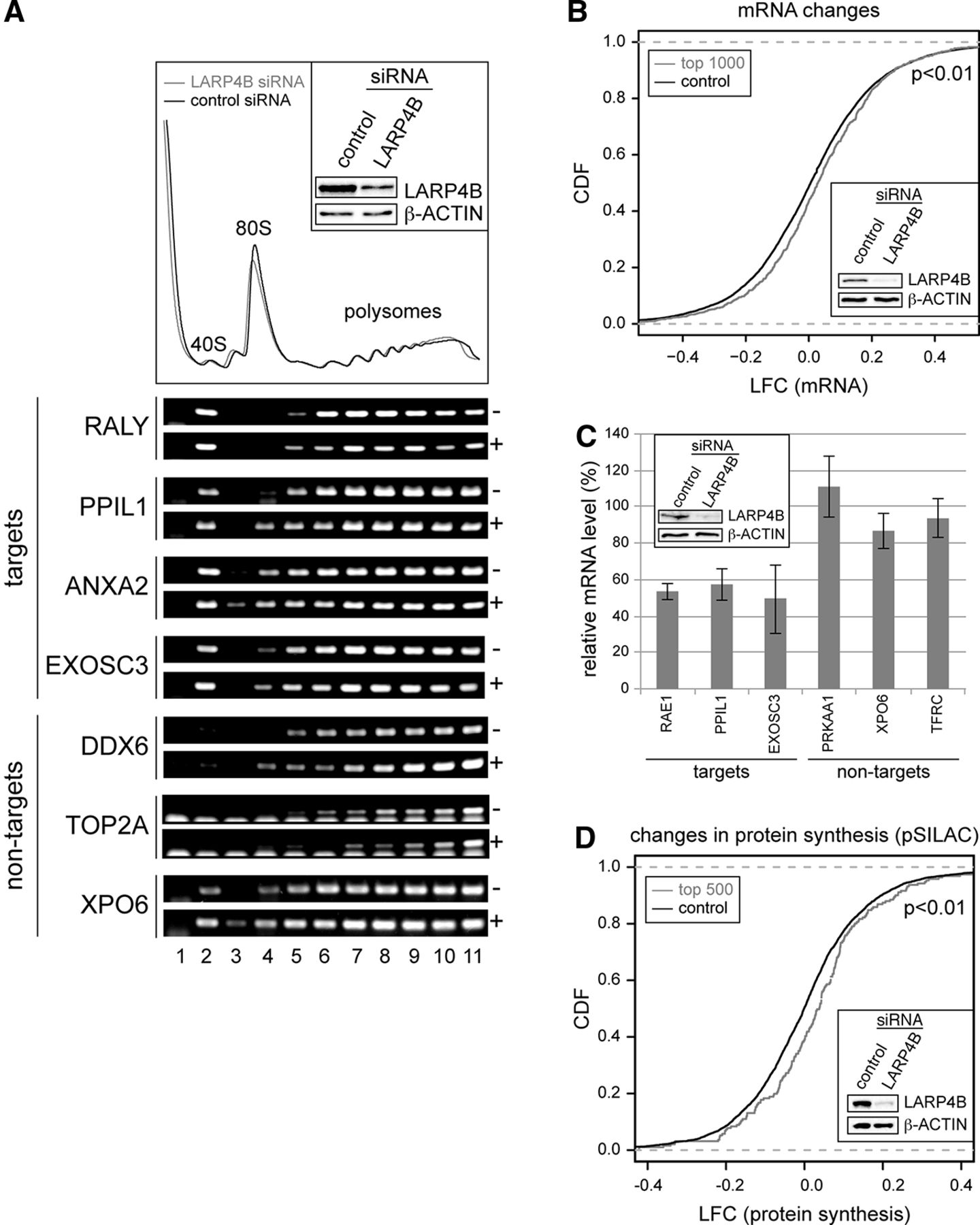
LARP4B increases target mRNA expression. (A) LARP4B does not affect association of mRNAs with the translation machinery. Cell extract of LARP4B knockdown (+) and control cells (−) were separated by density gradient centrifugation. Absorption profiles at 260 nm are shown indicating migration of 40S, 80S, and polysomes. RNA of the gradient fractions was extracted and analyzed by RT-PCR. The LARP4B knockdown does not affect sedimentation behavior of the analyzed mRNAs. (Inset) Knockdown of LARP4B was analyzed by Western blotting using anti-LARP4B and anti-actin antibodies. (B) LARP4B stabilizes target mRNAs. mRNA of LARP4B knockdown and control cells was isolated and analyzed by RNA-seq. Log2 fold changes in mRNA levels of top 1000 target mRNAs were compared with the remainder mRNAs in a cumulative distribution function (CDF) which shows a significant destabilization of the target mRNAs upon LARP4B knockdown. (Inset) Western blot to control for efficient LARP4B knockdown using anti-LARP4B and anti-actin antibodies. (C) Effect of LARP4B on target mRNA levels. RNA of LARP4B knockdown and control cells was isolated and relative mRNA levels of target and nontarget mRNAs were determined by qPCR confirming the stabilizing effect of LARP4B on analyzed target mRNAs. (Inset) Cell extracts of LARP4B knockdown and control cells were analyzed by Western blotting using anti-LARP4B and anti-actin antibodies. (D) Impact of LARP4B on the proteome. To analyze the effect of LARP4B in a proteome-wide scale a pSILAC assay was performed. Newly synthesized proteins in LARP4B knockdown cells were labeled using medium-heavy amino acids and in control cells using heavy amino acids. Differences in protein expression rates between LARP4B knockdown and control samples were assessed by mass spectrometry. Log2 fold changes in protein expression rate of the top 500 LARP4B targets were compared with the rest in a CDF. LARP4B knockdown leads to a significant decrease in target gene expression. (Inset) Western blot to analyze for LARP4B knockdown efficiency using anti-LARP4B and anti-actin antibodies.




