


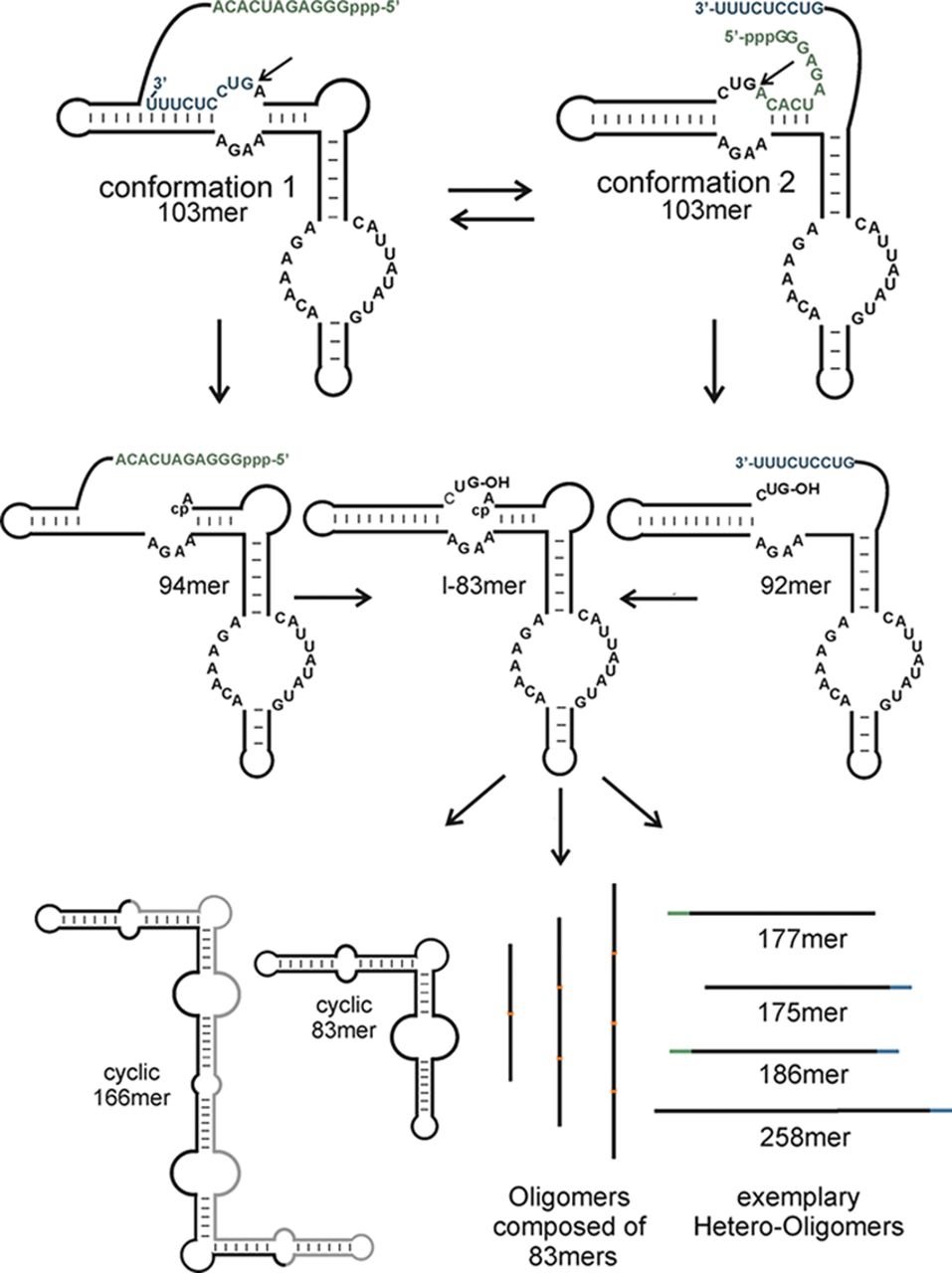
RNA self-processing pathway of CRZ-2. The pathway also applies to designed sequence variants PBD1 to PBD4 (see below). Note that fragment lengths differ for PBD3 and PBD4. RNAs are programmed to fold in two distinct conformations (top). Both conformations favor cleavage, such that either the 5′-terminus (green) or the 3′-terminus (blue) can be cleaved off, resulting in a 94- or 92mer (middle). These intermediates can refold in the conformation required for cleavage of the remaining 3′- or 5′-end, respectively. The final cleavage product is always an 83mer, which can undergo intramolecular ligation to a circular species (bottom, left) or self-concatemerize by intermolecular ligation (bottom, middle). In addition, the fragments resulting from the first cleavage contain either the 2′,3′-cyclic phosphate or the 5′-OH group required for ligation, such that they can also oligomerize with each other or with one or more 83mers (bottom, right).




