


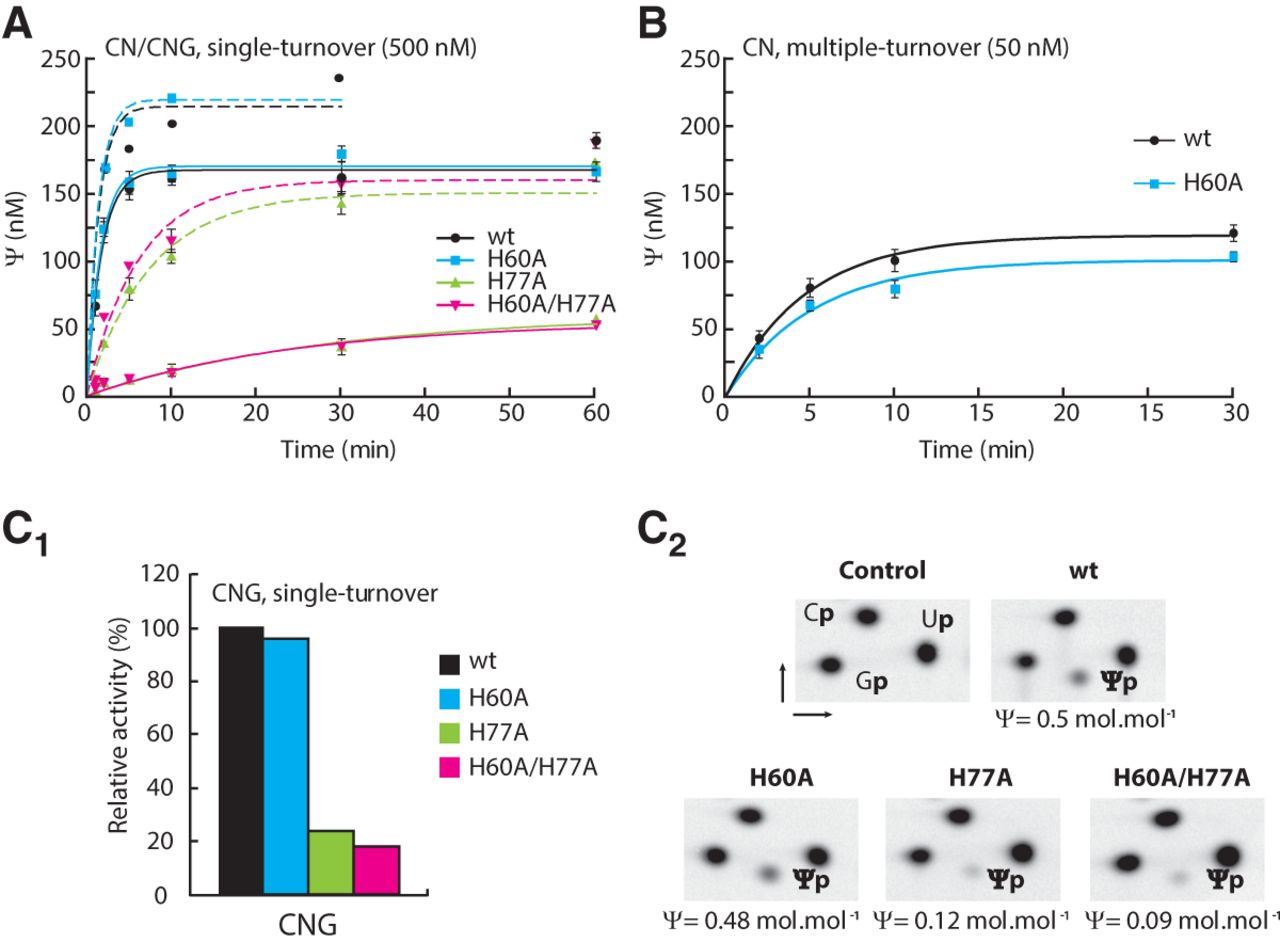
Both tRNA:Ψ55- and rRNA:Ψ2603-synthase activities of Cbf5 require H77 but not H60. (A) Time course analysis of Ψ formation by Cbf5 in the substrate P. abyssi tRNAAsp under single-turnover conditions. The extent of Ψ formation was quantified using the tritium release assay. [3H]tRNAAsp (0.25 µM) was incubated with Cbf5 (wt, H60A, H77A, and H60A/H77A) and Nop10 (continuous lines) or Nop10 and Gar1 (dashed lines) at 65°C. The concentration of the proteins was 0.5 µM. (B) Ψ formation by Cbf5 in tRNAAsp under multiple-turnover conditions as measured by the tritium release assay. 0.25 µM [3H]tRNAAsp was incubated with 0.05 µM Cbf5 (wt, H60A) and Nop10. (C) Analysis of Ψ formation in the RNA substrate rRNA2603. Reactions were performed under single-turnover conditions in the presence of 30 nM uniformly [α-32P]CTP radiolabeled rRNA2603 and 5 µM of the heterotrimer composed of the wild type and variant Cbf5 enzyme (in black) and proteins Nop10 and Gar1. The reaction was performed at 65°C for 90 min. Ψs were detected by the nearest neighbor method and the quantities were expressed as for substrate RNA 22-U in Figure 3C. The bar graph represents the relative percentage of Ψ formation compared with the wild type (panel C1). The panel C2 shows an example of 2D-TLC plates with the amount of Ψ formation indicated.




