


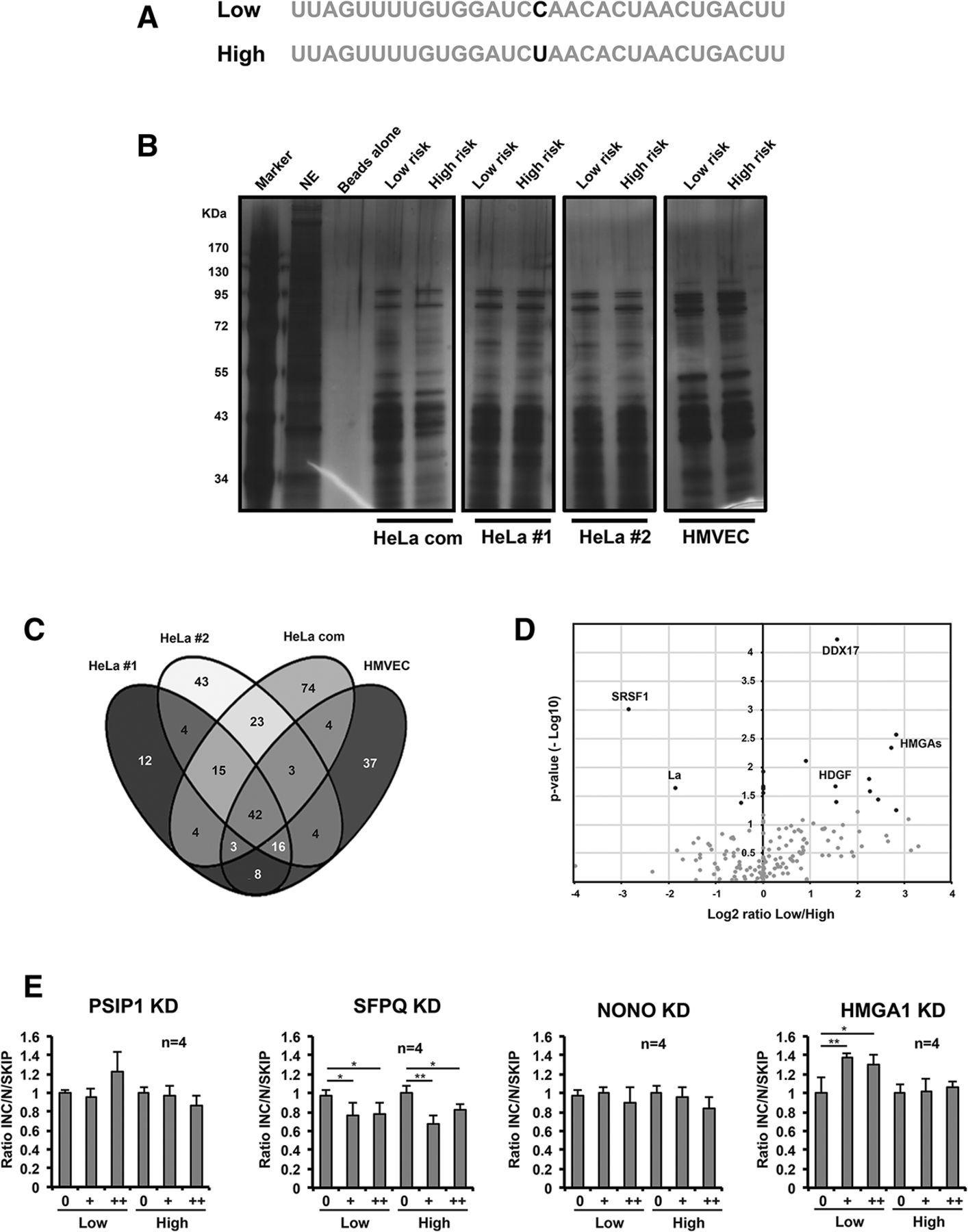
RNA affinity selection of potential OLR1 AS regulators. (A) RNA oligonucleotide sequences corresponding to the Low-Risk or High-Risk alleles used for RNA pull down experiments. (B) Proteins isolated after RNase-assisted RNA pull down using Low- or High-Risk RNA oligonucleotides or beads alone, incubated with nuclear extracts from different cell lines ([HeLa com] commercial nuclear extracts, [HeLa#1 and HeLa#2] HeLa nuclear extracts prepared in our laboratory, [HMVEC] human microvascular vein endothelial cells nuclear extracts, [NE] nuclear extracts) were fractionated by electrophoresis in SDS-polyacrylamide gels detected by silver staining. The experiment was performed in duplicate for each of the conditions. (C) Venn diagram indicating the number of overlapping mass spectrometry-determined proteins between the different nuclear extract conditions and replicates. Proteins bound to both alleles as well as proteins present across the different conditions were considered for further analysis. (D) Mass spectrometry analysis of protein abundance and ratio between Low- and High-Risk affinity chromatography results. Enrichment P-value is indicated, together with the ratio between Low and High binding enrichment. (E) Functional hit validation. HeLa cells were co-transfected for 48 h with Low- or High-Risk minigenes and siRNAs against the indicated factors ([0] scramble siRNA 100 nM, [+] siRNA 50 nM, [++] siRNA 100 nM). Values represent mean and standard deviations of exon 5 inclusion/skipping ratios for four independent biological replicas. Significant P-values obtained from Student's two-tailed heteroscedastic t-test are indicated: (*) <0.05, (**) <0.01.




