


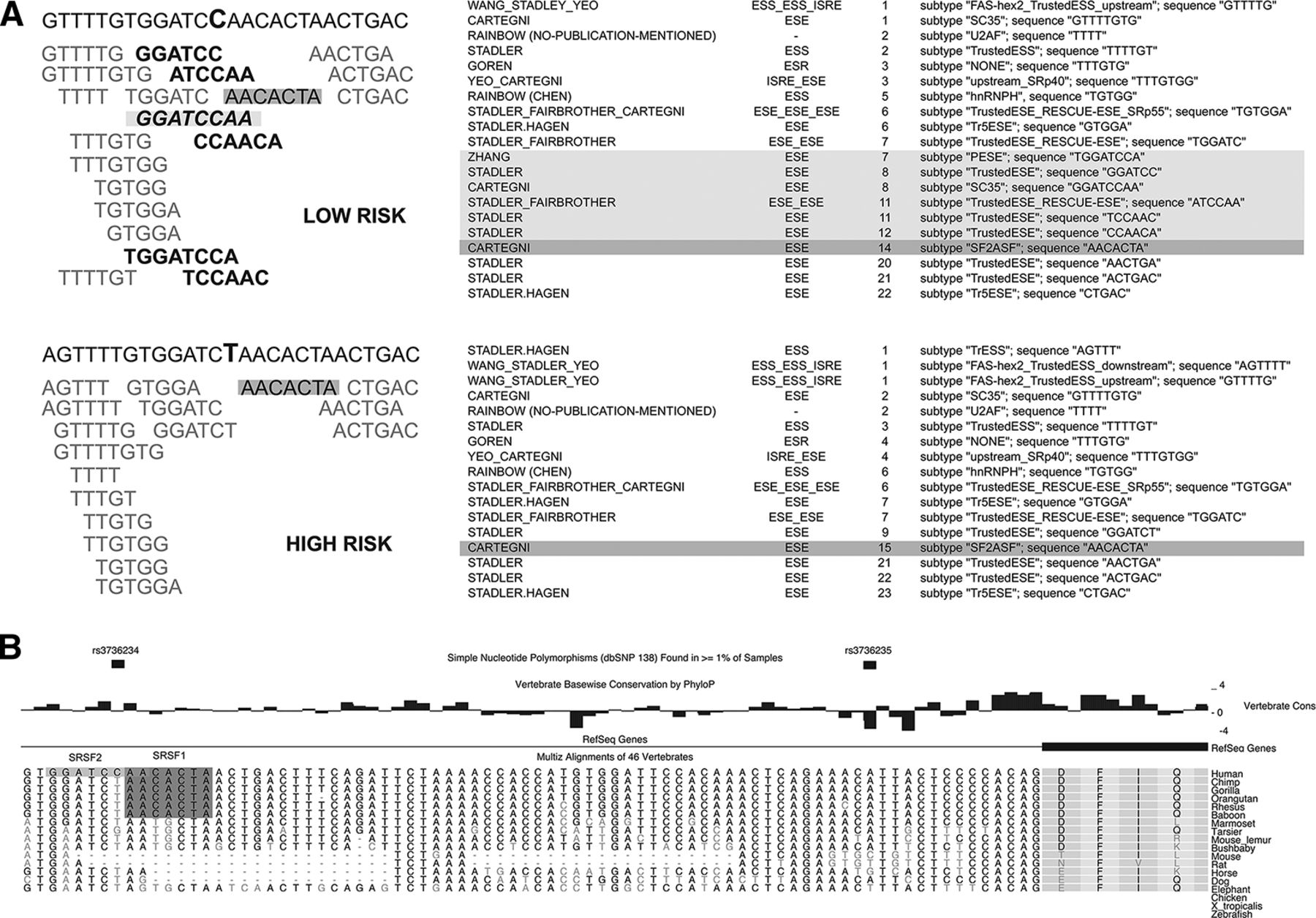
Bioinformatic identification of putative sequence regulatory elements in the vicinity of SNP rs3736234. (A) Potential sequence regulatory elements identified in silico in the sequences of Low-Risk (upper) or High-Risk (lower) RNAs around rs3736234. The identity of the nucleotide in each allelic series is indicated by bold bigger case. Light gray indicates sequence motifs common in both alleles, bold indicates motifs identified in the Low-Risk but not in the High-Risk allele, shadowed motif corresponds to a high score putative binding site for the SR protein SRSF1, the italicized motif indicates putative binding site for the SR protein SRSF2. The tables on the right indicate the putative regulatory motifs identified: their source, original classification ([ESS] exonic splicing silencer, [ESE] exonic splicing enhancer, [ISRE] intronic splicing regulatory element), location of the first nucleotide of the motif in the sequence analyzed (left), and description of the regulatory element. (B) Sequence alignment of OLR1 intron 4 3′ region across different vertebrate species. Potential overlapping SRSF2- and SRSF1-binding sites around SNP rs3736234 are indicated by light and dark shadowed boxes, respectively.




