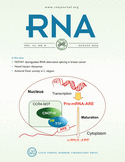
The new era of RNA modification
- John Karijolich1 and
- Yi-Tao Yu2
- 1Department of Plant and Microbial Biology, University of California, Berkeley, California 94720-3370, USA
- 2Department of Biochemistry and Biophysics, Center for RNA Biology, University of Rochester School of Medicine and Dentistry, Rochester, New York 14642, USA
- Corresponding author: yitao_yu{at}urmc.rochester.edu
This extract was created in the absence of an abstract.
Since the inception of the journal RNA in 1995, we have witnessed significant advances in a number of areas of RNA research. Among them is the area of RNA modification. In the mid-1990's, a “sno” storm hit the RNA field, leading to the identification of a large number of small nucleolar RNAs, known as box H/ACA and box C/D snoRNAs. The discovery of these RNAs generated a great deal of new interest in snoRNA research, which, in turn, led to a breakthrough in the area of RNA modification: It turned out that box C/D and box H/ACA RNAs exist in the cell as RNA-protein complexes, or snoRNPs (each snoRNA is complexed with four common proteins; Nop1/fibrillarin, Nop56, Nop58, and Snu13 for box C/D RNPs, and Cbf5/NAP57/Dyskerin, Nhp2, Gar1, and Nop10 for box H/ACA RNPs), and that the RNA component (box C/D RNA or box H/ACA RNA) of each RNP complex …